
Loading the latest stories…
Pockets—practical, convenient, and sometimes, so mysterious. Find them hidden inside or boldly stitched to the front of a garment.
Susan J. Jerome3 min read
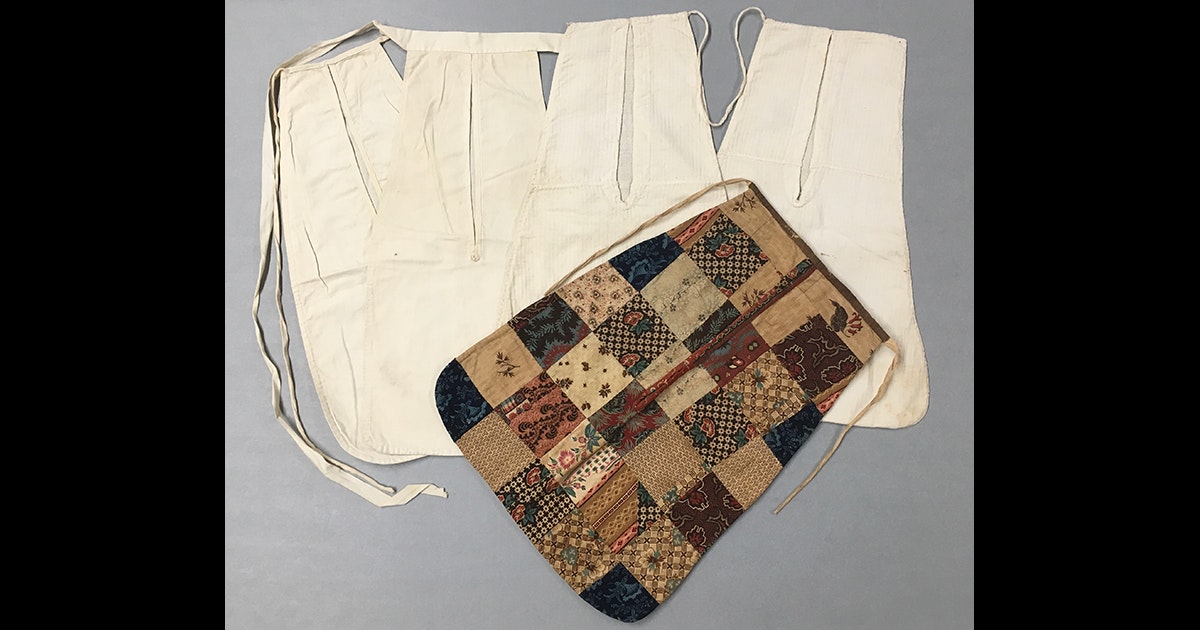
The first examples of pockets began to be inserted into men’s clothing at the end of the 1600s. Before this construction development, illustrations show that men used small pouches, which hung from a belt around the waist. These separate pouches could be concealed inside of a coat or tunic. The words pouch and pocket are related, through the Middle English/Northern French word pouche, originally describing a small bag.
For women, pockets remained an accessory that tied around the waist and was accessed through an opening in a skirt’s seam. The full skirts of the 1700s allowed these pockets to be easily hidden.
The political revolutions of the late eighteenth century produced a revolution in fashion for both genders. The change in women’s clothing was dramatic; no one wanted to look like those facing the guillotine in France. Fashionable dresses echoed the clothing thought to be worn by women in ancient Greece, with a slim silhouette and high waist. This fashion revolution included dress fabrics as well, with lighter cotton materials replacing the heavy brocades and silks of the previous century. This use of cotton materials corresponded to the technological innovations occurring in the textile industry as the Industrial Revolution gained momentum in England.
Early nineteenth century fashion plates show women carrying small bags, known as reticules, as an accessory. The dresses couldn’t accommodate a pocket. But by the 1840s, skirts once again became fuller, and dresses sometimes had a single pocket sewn into a skirt’s side front seam. These inseam pockets were easily constructed, providing a place for at least a handkerchief. This type of pocket can be found in dresses from the 1840s through the end of the century, a time when most dresses were made at home or by a dressmaker.
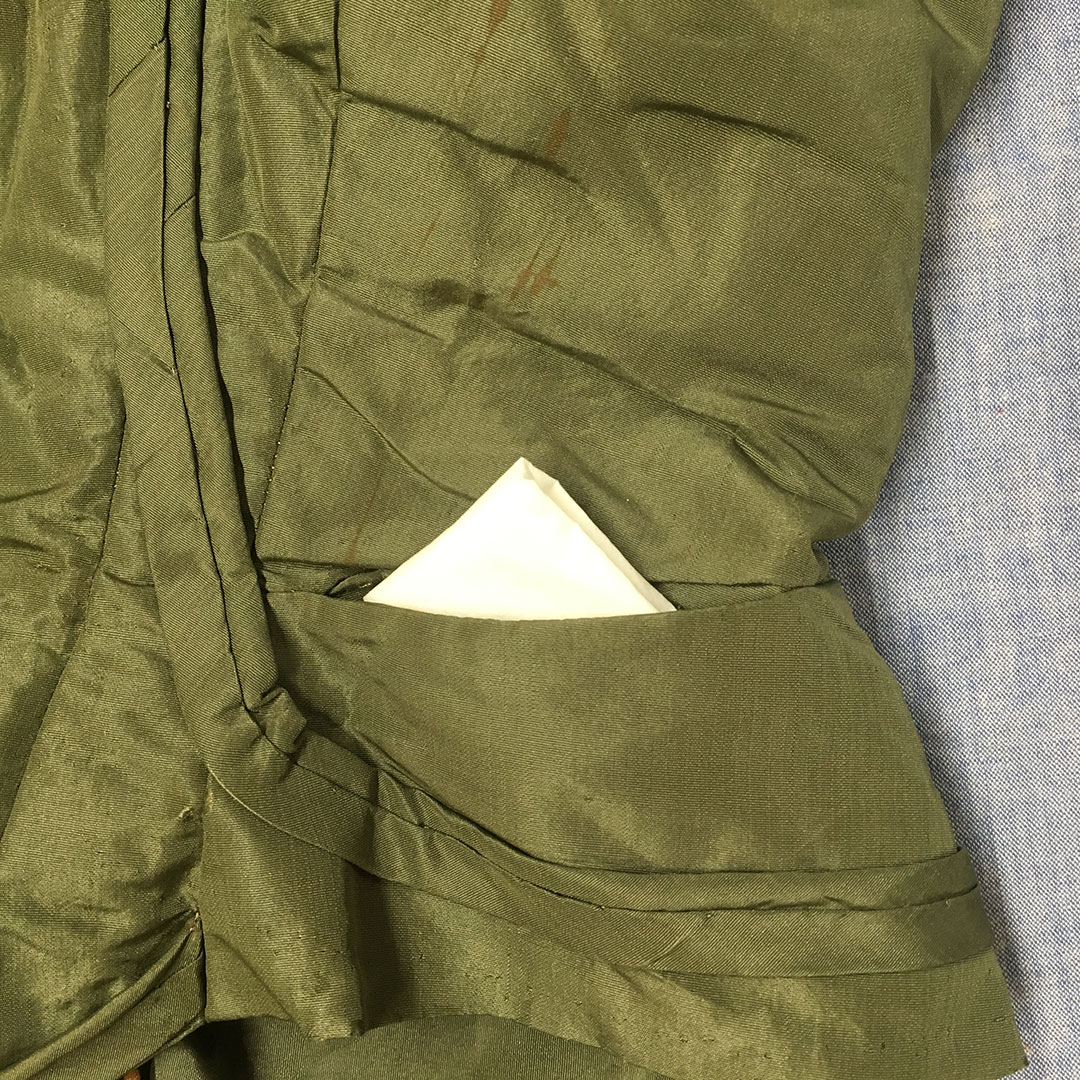
This tiny pocket is sewn into the horizontal dart of a bodice from the mid 1870s. The dart over the hip helps to fit the garment to the body. The fashionable lady wore a long necklace over her fitted top, with a pendant or watch tucked into a pocket such as this. This is a simple, in-seam dart construction. URI 1995.19.01a, b, c. Donor: Rhode Island School of Design. From the collection of Historic Textile and Costume Collection, University of Rhode Island.
But let’s skip ahead to the twentieth century, when several important ideas contributed to changing fashions and the use of pockets in women’s clothing. Women were fighting for the right to vote. During World War I, many women began working in jobs traditionally held by men. These circumstances triggered changes in fashion, with, again, a slimmer silhouette replacing the long, full skirts of the century before and the Edwardian era. Women’s clothing began to adopt styles and details from men’s attire. Pockets were part of this assimilation, clearly seen when women began wearing suits and trousers in the 1940s.
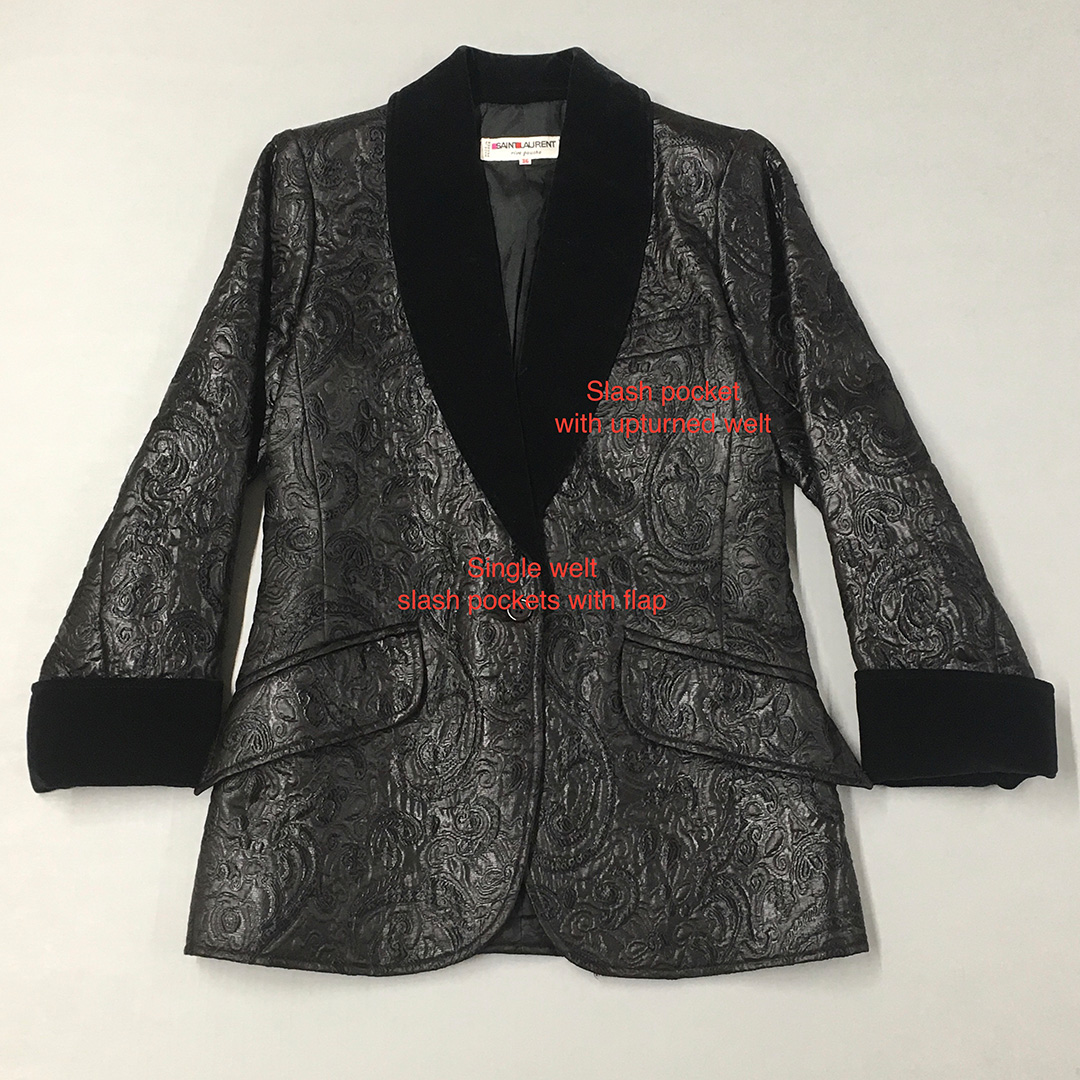
This matelassé jacket from the 1980s Rive Gauche collection of Yves Saint Laurent highlights the adaptation of men’s clothing by women in the twentieth century. This type of pocket can be found in men’s garments from the 1700s. The pockets at each hip and left chest are made by cutting through the garment fabrics. They are a type of slash pocket. The welts are inserted to cover the raw edges and stabilize the ends, while the flap is meant to keep the contents secure. The pocket is basted shut during sewing; the owner should remove this stitching. A number of suits, for both men and women, in the Historic Textile and Costume Collection have these types of pockets never opened for use. URI 1987.20.12. Donor: Mr. and Mrs. Miles Fitterman. From the collection of Historic Textile and Costume Collection, University of Rhode Island.
Today, pockets on women’s clothing can be practical or just a design element. Some have questioned the gender neutrality of pockets, particularly noting differences between pockets in clothing identified as men’s or women’s in some of today's garments. A search of the Internet for “pockets and politics” or the “history of pockets” provides some thoughtful commentary on this subject.
Burman, Barbara and Ariane Fennetaux. The Pocket: A Hidden History of Women's Lives, 1660 - 1900. New Haven, Connecticut: Yale University Press, 2019.
www.vam.ac.uk/content/articles/a/history-of-pockets
Susan J. Jerome is collections manager at the University of Rhode Island Historic Textile and Costume Collection. She earned her MS degree from the University of Rhode Island, Department of Textiles, Fashion Merchandising, and Design. Prior to continuing her education, she worked for a number of years at Mystic Seaport Museum. She lectures on topics of fashion history and needlecraft; works as a textile and quilt conservator; and is a consultant to museums and historical societies. An avid textile enthusiast, she is happiest when writing, talking, and doing all things textile.
More from PieceWork
 Discover a Digital Home for Knitting and Crochet HistoryThe Center for Knit and Crochet is building a free, open-access digital museum where collections big and small, famous and personal, finally have a home. Jennifer Lindsay · July 20, 2026
 Hooked on History: The Surprising Collection of Hamilton House RugsA visit to a historic mansion in Maine revealed an unexpected collection of hooked rugs that inspired this dazzling rug-hooking project in PieceWork.Karen Elting Brock · July 16, 2026
 Honiton Lace: One of England’s Loveliest LacesExplore the history of this British bobbin lace with a pattern to try yourself, plus a bonus deep dive into a Bucks Point lace edging.Jo Ann Eurell · July 13, 2026
 Long Thread Podcast: Loretta Pettway Bennett, Gee’s Bend QuilterSeason 15, Episode 2: A fifth-generation quilter from the legendary community of Gee’s Bend, Alabama, Loretta Pettway Bennett turns well used cloth into her own expressions of color and community.Anne Merrow · July 11, 2026
 Explore Our Cabinet of Wonders! Discover textile treasures from museums around the world in our Fall 2026 issue of PieceWork.Karen Elting Brock · July 9, 2026
 Flower Power! Vintage Flowers Made SimpleFrom fabric blossoms to daisy loom flowers, learn how to make your own little garden with these vintage techniques. Karen Elting Brock · July 6, 2026
 And He Called It MacaroniIf you’ve ever wondered at the meaning behind the lyrics of “Yankee Doodle,” it might surprise you to learn that the “macaroni” in the song referred not to a noodle, but to a rather odd fashion trend.Christina Garton · July 2, 2026
 Stitching America’s Story: A 500-Foot Quilt for the Nation’s 250th BirthdayAs our nation approaches its 250th birthday, learn about one quilt that aims to stitch together the stories, struggles, and triumphs that built America.Erin Rodewald · June 29, 2026
 The Sparkle of Tradition: How Nineteenth-Century Europe Perfected Knitting with BeadsFrom the Baltics to Britain, learn how nineteenth-century knitters transformed simple wrist warmers and sleeves into dazzling garments with hundreds of tiny glass beads —and get the pattern to knit your own!Carol Huebscher Rhoades · June 25, 2026
 Stitching a Tribute and a MemoryWhat do we do with needlework heirlooms that we cannot let go?Linda Ligon · June 22, 2026
From the Library


Comments
No comments yet — be the first to share your thoughts.
Sign in to join the conversation — commenting is for signed-in members.