
Loading the latest stories…
This embroidered dowry bag bridges the gap between the traditional and modern. The shape meets the demands of current trends, but the stitching pays tribute to the needlework of vintage dowry bags.
Chitra Balasubramaniam2 min read

In an earlier post on bagchi dowry bags, I wrote about how small bags filled with gifts are traditionally given during the wedding ceremony. Today, traditional bagchi have been replaced by store-bought leather wallets and purses. The bag shown here bridges the gap between the traditional and modern and is inspired by current-day wallets and purses in shape and style, but it also has embroidered embellishments, which are a nod to the rich needlework of the past.
This is another of those pieces that I acquired at a market, and it was sold to me by a Kutchi embroidery lady’s husband. The bag had been made by his sister. I am not sure whether it was her dowry piece, made for her husband, or made for her daughter’s trousseau, but like many women wishing to cash in on extra textile pieces in their possession, she had given it to her brother to sell in Delhi. I was shown the piece and fell in love with it.
The bag is in the form of a wayfarer’s pouch and provides enough space to hold toiletries or other similar items. Its shape is more three dimensional than traditional bagchi for it has more depth and height to it, expandable sides, a little handle, and like many modern purses, it closes with a plastic zipper. It measures 7½ x 6 inches (19.1 x 15.2 cm), 2 inches (5.1 cm) deep, and the handle is 7 inches (17.8 cm) long.
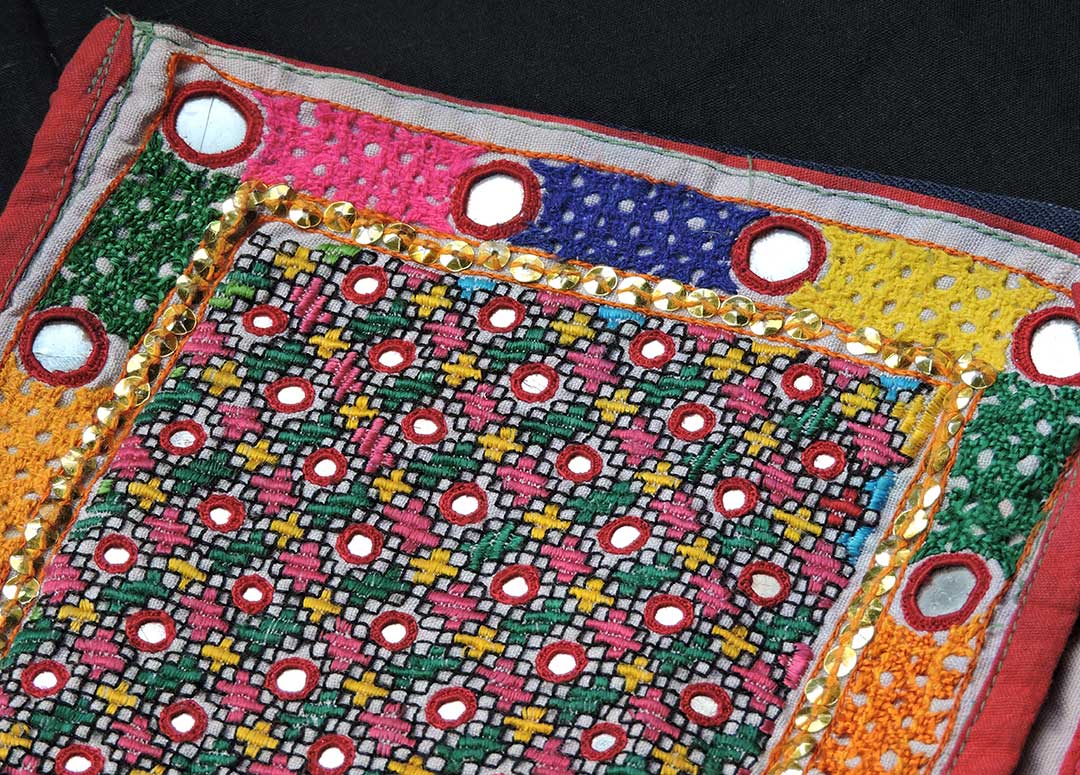
Detail of the of the kharek and sindhi taropa embroidery stitches. The bag is the same on both sides, and it is difficult to achieve such symmetry given the intricacy of the design.
However, this bag retains the colorful elements of traditional bags with its exquisite embroidery. It was lovingly made for someone special and has been embroidered using three types of stitches. The center is embroidered in very fine kharek, or khareek, embroidery. Kharek in local dialect means dates, which is what the stitches resemble, and this style of needlework came to India with the Sodha Rajputs who migrated from the Tharparkar region in the Sindh province of Pakistan, during the Indo-Pakistani War of 1971. The bag’s embroidery is very intricate with tiny mirrors in between the embroidery, and the kharek stitching around the mirrors is so fine that one can hardly see it. The sides of the bag, the expandable portion, and the handle are decorated using suf embroidery, which is practiced in the Kutch region of Gujarat in western India. This bag looks the same on both sides, and the sides of the center piece on the front and back of the bag are finished using the sindhi taropa, or hurmucho, which is also a Kutch style of needlework.
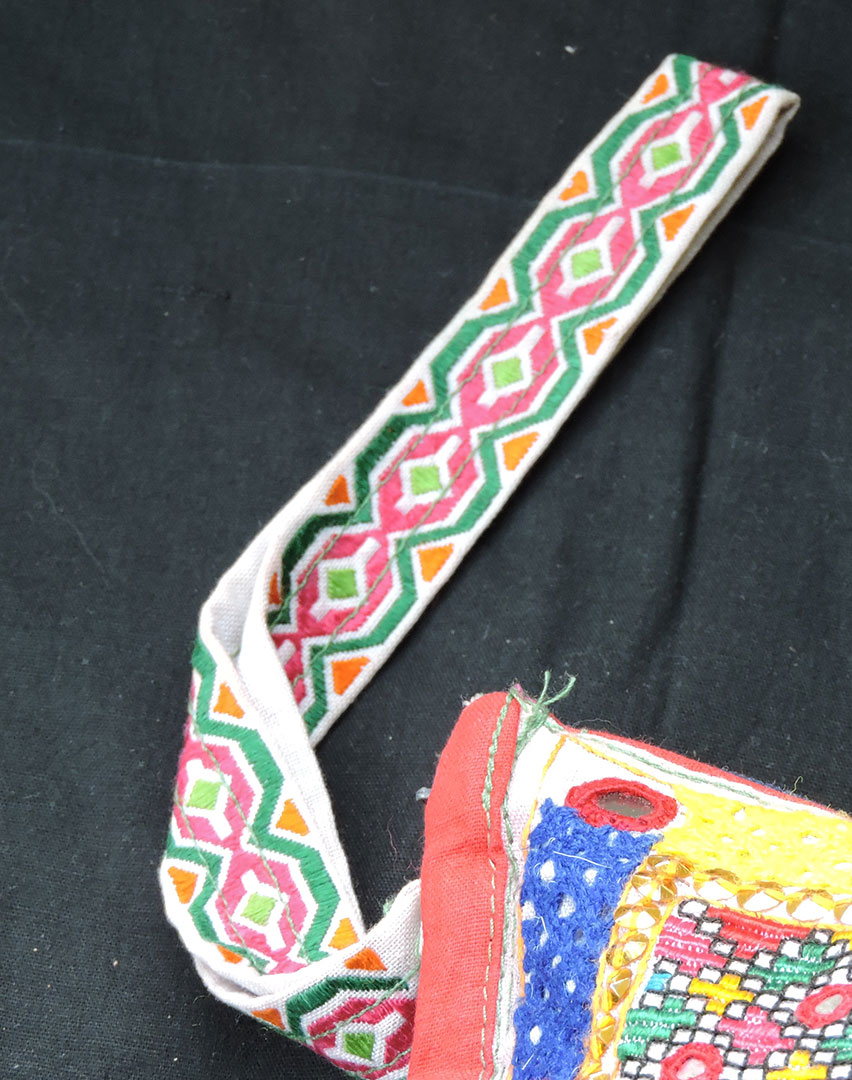
Detail of the suf embroidery on the handle.
This textile example from my collection shows the evolution of dowry items in the Kutch region. The traditional-shaped pieces are being replaced by modern-day versions. While the bag’s shape may have changed, the rigor of the embroidery is maintained, and the tradition thrives. This bag is an interesting progression of the bagchi I wrote about previously, and it documents how dowry items change with time.
Chitra Balasubramaniam writes, collects, experiments with textiles, and follows her passions by writing about food, travel, and heritage. She dabbles with stock-investment analysis and research. She also runs a small travel guide at visitors2delhi.com. Find her on Instagram as @visitors2delhi.
More from PieceWork
 Happy World Embroidery Day Join us on a journey around the world to celebrate the makers keeping this ancient craft alive.Karen Elting Brock · July 30, 2026
 Infinite Blue: Exploring Indigo as Art and Process Indigo has long been valued for both its technical precision and expressive depth. An exhibition at the Indigo Art Museum traces how artists turn a traditional dyeing process into a powerful visual language.Dr. Japjee Kaur Kohli · April 27, 2026
 Photo Extras from "Bakhiya: A Tale of Tiny Stitches"Take a closer look with these bonus images featuring the vibrant embroidery traditions of Kutch, India from our Winter 2025 Folk Wear issue.Karen Elting Brock · October 8, 2025
 Unraveling the Mystery of a Sodha Rajput Masala BagFollow an Indian textile collector on her quest to discover the origins of her newly acquired bag.Chitra Balasubramaniam · August 25, 2025
 Reviving the Art of Traditional Indian Batik Using natural dyes, the sixth generation of a dyeing family breathes new life into traditional batik printing.Satish Reddy · August 11, 2025
 Ledra Quilts: Giving New Life to My Mother’s SareesPeel back the layers of recycled sarees to uncover the history of ledra quilts in India. Find out how the handstitched motifs rejuvenate reused textiles into striking works of needle art.Chitra Balasubramaniam · April 2, 2025
 Visible and Invisible Mending: Darning, Kantha, BoroPatched and mended fabrics can have a reputation as shabby, but stitchers around the world have developed a variety of mending methods to turn holes into badges.A. K. Fielding · July 22, 2024
 Chantilly Lace in IndiaA query about how French lace goods came to be used as a saree fabric in India resulted in a search for more information. Chitra Balasubramaniam shares what she discovered.Chitra Balasubramaniam · December 14, 2022
 Banjara Dowry PurseThe Banjara embroidery design on a small dowry purse comprises simple squares, rectangles, and line work. But oh! The colors!Chitra Balasubramaniam · June 22, 2022
 Chakla—Part of a Collective VocabularyCan a simple square piece of cloth decorated with fine embroidery be a part of the collective heritage of a community? The answer is yes when it comes to the chakla.Chitra Balasubramaniam · March 9, 2022
From the Library


Comments
No comments yet — be the first to share your thoughts.
Sign in to join the conversation — commenting is for signed-in members.