
Loading the latest stories…
The Norwich, waffle, southern cross, or plaited interlaced stitch is considered to be a large, square, highly textured, modern-day canvas and needlepoint stitch.
Deanna Hall West4 min read
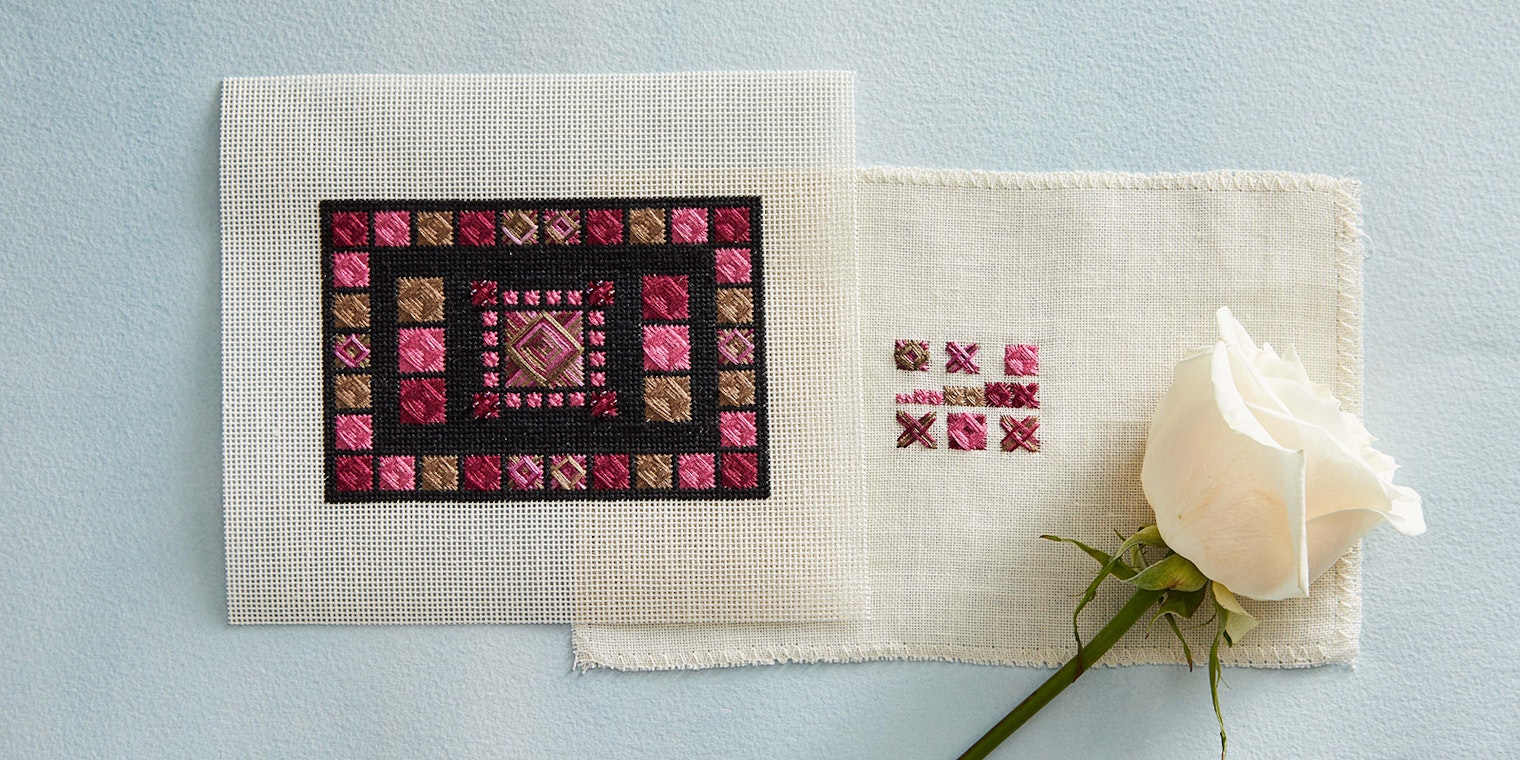
The Norwich, waffle, southern cross, or plaited interlaced stitch is considered to be a large, square, highly textured, modern-day canvas and needlepoint stitch. It is composed of a raised diamond superimposed upon a stitched square. Normally, it's worked over an uneven number of background threads.
I found this stitch to be called the Norwich or waffle stitch in equal frequency in the literature. This is somewhat unusual because one name usually predominates. Personally, I prefer the Norwich name because of less confusion; there is another embroidery stitch called a waffle stitch that consists of rows of small straight stitches. There are also waffle stitches in both knitting and crochet. How the “Norwich” appellation originated remains a mystery.


The Norwich stitch always begins with a large crossed stitch with numerous legs stitched over the original crossed stitch (Figure 1) and is commonly worked over 7 (Figure 2) or 9 threads, but thread counts of 3 (Figure 1), 5, 11, 13, 15, and even more have been used. Stitching over 3 x 3 threads limits the size and definition of the raised inner diamond shape. Of course, the larger the number of threads this stitch encompasses, the more complex and time-consuming the stitch becomes. It can be worked over an even number of threads but with a slight modification: the center hole along each side is left empty. There are a couple of simple and logical variations for this stitch: a partial or incomplete stitch (Figures 4 and 5), and the final leg of the Norwich stitch can be woven under the last leg that it crosses, which continues the established stitching pattern (Figure 1, 5 x 5) or not (Figure 1, 3 x 3). Weaving under the last diagonal stitch is especially important for partial stitches, but for complete stitches, the end of the last leg ends at the edge of the stitch, so it is not as noticeable. On the back of the fabric, this stitch forms an open box of multiple strands (Figure 3).


Because of the numerous legs and the compound nature of this stitch, it is usually illustrated with numbers only around the periphery of the stitch (Figure 3). Bring the needle to the front of the fabric at the odd numbers and return to the fabric back at the even numbers. Following this many numbers can not only be tedious, but can easily lead to a mistake. See Figure 8 for a simplified “road map” one can follow after completing the initial crossed stitch, which establishes the outer dimensions of the stitch. Bring the needle up in the hole above where the crossed stitch started (leg 1), stitch a long diagonal stitch (legs 5 and 6) parallel to the first leg of the crossed stitch (legs 1 and 2), travel horizontally to the left and bring needle up in hole next to 4 and then diagonally down into hole above 3; bring needle vertically up into hole directly below 2; travel diagonally down to hole to the right of 1; horizontally to the right to hole left of 3; and diagonally up to hole directly below 4. Round One is complete. Continue in this manner around the square. Remember: vertical down, diagonal up, horizontal and diagonal down, vertical up, diagonal down, horizontal and diagonal up. Continue in this manner until square is completely or partially filled, as desired.


This popular stitch can be worked on most types of evenweave fabric, mono canvas, and linen. Linen fabrics need to be of a heavier quality or heavily starched to be able to handle the density of this stitch. The Norwich stitch is worked using a tapestry needle and always with the ground fabric under tension from a roller frame, stretcher bars, or hoop. To prevent warping the ground fabric, do not pull the individual legs of the stitch; this is especially true for fabrics other than needlework canvas.

This Norwich Stitch Sampler used 3 strands of floss for each of the Norwich stitches (3 x 3, 5 x 5 partial, 7 x 7, 9 x 9, and 15 x 15) and 4 strands of #310 for the continental stitch, which was used for the background. Beads were attached with 1 strand of #310.
Almost any type of thread (cotton or silk floss), yarn (tapestry or Persian), and even narrow ribbon can be used as long as the weight of the fiber is compatible with the gauge of the canvas or the thread count of the fabric. Smooth threads or yarns work best. Fuzzy yarns or threads will obscure the appearance of the stitch, and stiff threads (some metallics) will not lay smoothly on the ground fabric. One, two, three, or more thread colors can be used per stitch (Figures 6 and 7). Variegated and overdyed threads are especially fun to use and create a visual wow factor. The completed stitch is a wonderful surprise! When using multiple fiber strands (such as floss), keep the individual strands as parallel as possible by railroading for the best coverage, appearance, and shine.

The Norwich Stitch on Linen Sampler Key: 1) #4504, 2 strands, 11 x 11; 2) partial, #4504, 2 strands, 11 x 11; 3) #3687, 2 strands, 11 x 11; 4) #3687, 1 strand, 3 x 3; 5) #3687, 1 strand, 5 x 5; 6) #3790, 1 strand, 7 x 7; 7) #3685, 1 strand, 9 x 9; 8) partial, #3685, 2 strands, 9 x 9; 9) partial, #4504, 2 strands, 13 x 13; 10) base #3685, top #3687, 2 strands, 13 x 13; and 11) partial, base #3790, middle #3687, top #3685, 13 x 13.
The Norwich stitch can be used as a single isolated motif (partial or full) or grouped together for complex-looking bands, borders, and backgrounds. Two or three rows of alternating black and white Norwich stitches make a great checkerboard band or border.
—Deanna Hall West
Deanna Hall West is PieceWork’s needlework technical editor; she was previously the editor of The Needleworker magazine.
More from PieceWork
 Discover a Digital Home for Knitting and Crochet HistoryThe Center for Knit and Crochet is building a free, open-access digital museum where collections big and small, famous and personal, finally have a home. Jennifer Lindsay · July 20, 2026
 Hooked on History: The Surprising Collection of Hamilton House RugsA visit to a historic mansion in Maine revealed an unexpected collection of hooked rugs that inspired this dazzling rug-hooking project in PieceWork.Karen Elting Brock · July 16, 2026
 Honiton Lace: One of England’s Loveliest LacesExplore the history of this British bobbin lace with a pattern to try yourself, plus a bonus deep dive into a Bucks Point lace edging.Jo Ann Eurell · July 13, 2026
 Long Thread Podcast: Loretta Pettway Bennett, Gee’s Bend QuilterSeason 15, Episode 2: A fifth-generation quilter from the legendary community of Gee’s Bend, Alabama, Loretta Pettway Bennett turns well used cloth into her own expressions of color and community.Anne Merrow · July 11, 2026
 Explore Our Cabinet of Wonders! Discover textile treasures from museums around the world in our Fall 2026 issue of PieceWork.Karen Elting Brock · July 9, 2026
 Flower Power! Vintage Flowers Made SimpleFrom fabric blossoms to daisy loom flowers, learn how to make your own little garden with these vintage techniques. Karen Elting Brock · July 6, 2026
 And He Called It MacaroniIf you’ve ever wondered at the meaning behind the lyrics of “Yankee Doodle,” it might surprise you to learn that the “macaroni” in the song referred not to a noodle, but to a rather odd fashion trend.Christina Garton · July 2, 2026
 Stitching America’s Story: A 500-Foot Quilt for the Nation’s 250th BirthdayAs our nation approaches its 250th birthday, learn about one quilt that aims to stitch together the stories, struggles, and triumphs that built America.Erin Rodewald · June 29, 2026
 The Sparkle of Tradition: How Nineteenth-Century Europe Perfected Knitting with BeadsFrom the Baltics to Britain, learn how nineteenth-century knitters transformed simple wrist warmers and sleeves into dazzling garments with hundreds of tiny glass beads —and get the pattern to knit your own!Carol Huebscher Rhoades · June 25, 2026
 Stitching a Tribute and a MemoryWhat do we do with needlework heirlooms that we cannot let go?Linda Ligon · June 22, 2026
From the Library

Comments
No comments yet — be the first to share your thoughts.
Sign in to join the conversation — commenting is for signed-in members.