
Loading the latest stories…
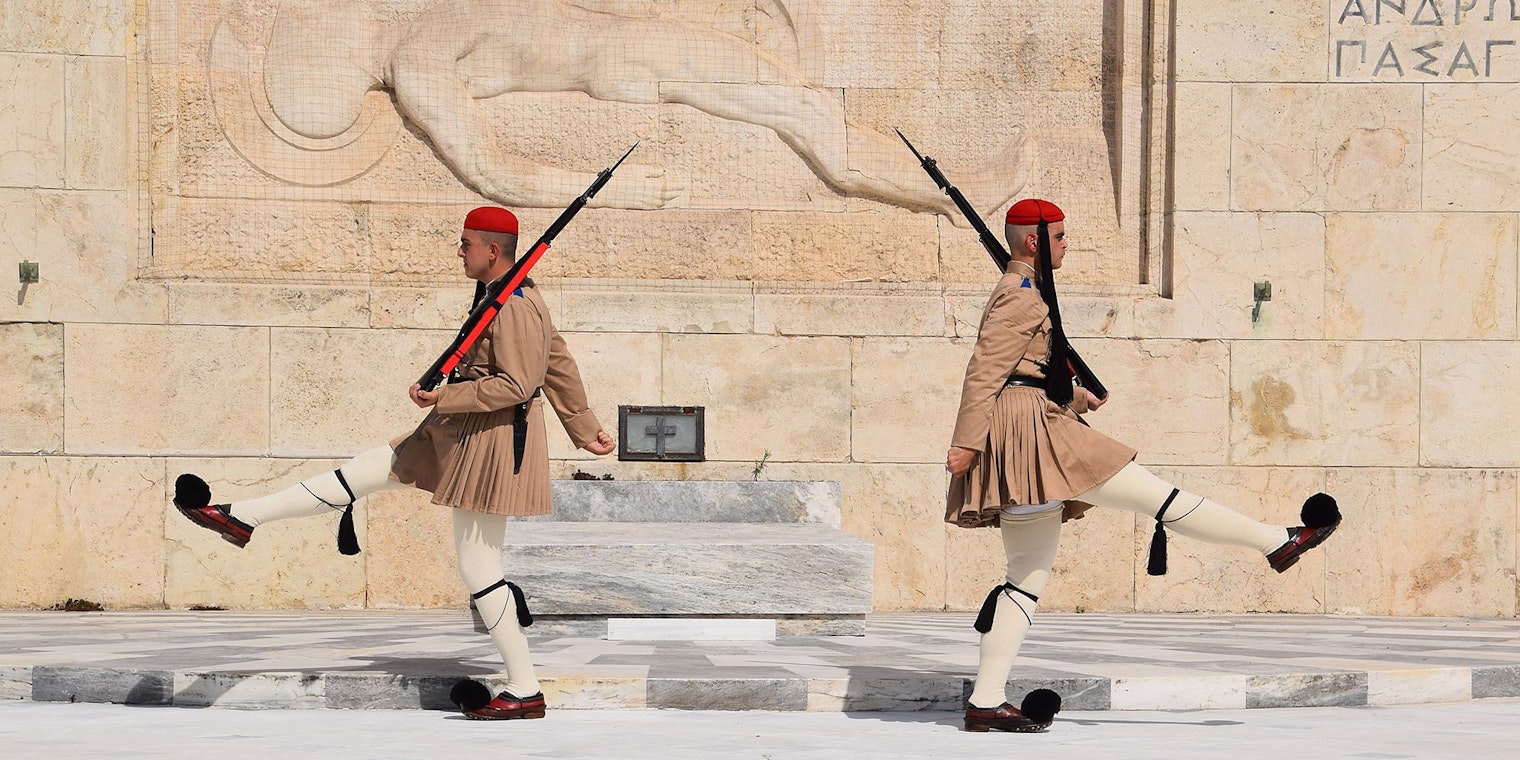
The traditional uniform of the Evzone Guards of Greece is as unique as the guards themselves.
Harikleia Sirmans4 min read
An empty space in my family’s photo album takes the place of a photograph long lost. In the photograph, my father proudly posed in front of the Parliament House in downtown Athens, Greece. He was 22 years old and serving his obligatory military training. His superior officers chose him to join the National Guard or Evzones.
 Left: The author’s father at age 17, a few years before serving in the Evzones. Photo courtesy of Harikleia Sirmans. Right: A member of the Evzones in ceremonial clothing, Tomb of the Unknown Soldier, Athens, Greece. Photo by Jebulon
In the photo of my father, he stands motionless and expressionless. He was not allowed to flinch or utter a word for an entire hour. He had to stand there inert and straight-faced, rain or shine. He wore a white kilt-like skirt called fustanella, a white tunic with wide sleeves under a black hand-embroidered waistcoat, white leggings, clog-style shoes called tsarouhia, and a wool fez on his head. How handsome and proud he looked! I was curious as to the expert hands that had made the beautiful stitches on the waistcoat and how long they took to make them.
Let me delve a bit deeper on the making of this uniform and how it came to life: Evzones (Greek: Εύζωνες, which means “well-girdled”) were elite light infantry and mountain units of the Greek Army that fought the Greek War of Independence against the Ottoman Empire (1821–1829). Their distinctive fustanella uniform evolved from the traditional dress of the klephts (Greek: κλέφτες, meaning “thieves”). Klephts were Greeks who refused to obey Turkish rule and fled to the rugged mountains. They lived as thieves, but they were the ones who formed the core of the resistance to the Ottoman occupation of Greece. After the war, King Otto, the first king of Greece (1815–1867, ruled 1832–1862), declared the fustanella as a symbol of Greek national pride, bravery, and resistance. He imposed it on the royal court, the military, and the government officials.
The everyday Evzone uniform is a long tunic called doulamas (Greek: ντουλαμάς). In the hot summer months, Evzones dress in a thin khaki-colored cotton tunic, as shown in the opening photo. In the cold winter months, they wear a thicker navy-blue wool tunic. On special occasions, the Evzones wear the Uniform of the Islands, a Cretan-style uniform, to honor the war fighters of the Greek islands.
 Portrait of John B. Carmac in Greek Evzone Costume, painted by Walter Gould (1829–1893) soon after he traveled to Greece and Turkey. Courtesy of Smithsonian American Art Museum, Museum purchase
The formal Evzone uniform is white, and it is worn on Sundays, bank holidays, and formal visits. These formal uniforms are labor-intensive and costly because each one is handmade and embroidered by several tailors at the Presidential Guard training camp. Only men can wear them.
The formal uniform includes several notable pieces.
Zone (Greek: ζώνη): A black leather belt with a bayonet case.
Ypodetes (Greek: υποδήτης): A white shirt with wide sleeves.
Fustanella (Greek: φουστανέλα): A kilt-like skirt made of 30 meters (98 feet) of white fabric with 400 pleats that represent the 400 years of the Turkish occupation. The white of the ypodetes and fustanella represents the purity of the national independence struggles.
Fermeli (Greek: φέρμελη): A hand-embroidered waistcoat and the hardest part of the uniform to prepare. It takes one month and ten tailors to embroider various traditional designs in white or gilt wool thread. To highlight the borders of the fermeli, tailors may use gold rickrack trim or cord. They sew the cord on the fabric with a simple couching stitch to create designs such as simple lines, swirls, spirals, and crosses. One of the embroidered designs is the military rank of the guard. The fermeli is made of wool or velvet fabric, usually in black or red. It is worn over the ypodetes.
Pharion (Greek: φάριον): A scarlet wool fez (cap) with the appliqué of the national emblem of Greece sewn on the front and a long black silk tassel. The national emblem consists of a white cross in a blue crest with two surrounding laurel branches. The pharion represents the sacrifices and blood of revolutionaries.
Periskelides (Greek: περισκελίδες): Two pair of white woolen stockings, perhaps to prevent blisters.
Epiknemides (Greek: επικνημίδες): Garters made of black silk, decorated with a tassel, and fastened below each knee.
Tsarouhia (Greek: τσαρούχια): Distinctive clog-style shoes made of handstitched red cowhide. Each shoe weighs 1.5 kilograms (3.3 pounds) and has 60 nails embedded into its sole. The toe of each shoe points upward and is decorated with a large silk black pompom.
 Greeks in Fustanella, Athens. Courtesy of the Library of Congress, Prints and Photographs Division
The origins of fustanella can be traced to the traditional outfits worn by the brave revolutionaries during the Ottoman occupation. Today, it’s not only the Evzones who wear the fustanella as they stand in splendor in front of the Parliament House, but also folk dancers and schoolchildren when they parade in the streets on ceremonial occasions and national holidays.
Chrysoula. “The Evzones & the Changing of the Guards in Athens.” Athens & Beyond, June 10, 2020. https://athensandbeyond.com/evzones-the-changing-of-the-guards-in-athens/
Kampouris, Nick. “The Presidential Guard: How Evzones Became a Potent Symbol of Greece.” Greek Reporter, December 12, 2021. https://greekreporter.com/2021/12/12/presidential-guard-evzones-potent-symbol-greece/
“The Evzone Tailors of Greece,” LFC Design Blog, January 28, 2016. https://anastasiagerali.blogspot.com/2016/01/the-evzone-tailors-of-greece.html
Harikleia Sirmans is known for her many talents. Among other things, she’s an academic librarian and an expert dressmaker. She loves sewing and needlework, and every evening, she crochets to relax. She was born and raised on the island of North Evia, Greece. Today, she lives with her husband in Valdosta, Georgia, and she makes beds, sweaters, and collars for their furry kids. Visit her at grecianneedle.com.
More from PieceWork
 Why Blue and White? The Changing Threads of Medical UniformsToday’s medical uniforms are more than dress codes in blue and white. As tools for safety, comfort, and identity, they tell a story of how healthcare workers have reshaped what it means to dress for care.Caitlin Doran · April 23, 2026
 History of the BeretWhat if I told you the origin of the beret wasn’t entirely French?Sheena Pennell · July 1, 2024
 Discover a Digital Home for Knitting and Crochet HistoryThe Center for Knit and Crochet is building a free, open-access digital museum where collections big and small, famous and personal, finally have a home. Jennifer Lindsay · July 20, 2026
 Hooked on History: The Surprising Collection of Hamilton House RugsA visit to a historic mansion in Maine revealed an unexpected collection of hooked rugs that inspired this dazzling rug-hooking project in PieceWork.Karen Elting Brock · July 16, 2026
 Honiton Lace: One of England’s Loveliest LacesExplore the history of this British bobbin lace with a pattern to try yourself, plus a bonus deep dive into a Bucks Point lace edging.Jo Ann Eurell · July 13, 2026
 Long Thread Podcast: Loretta Pettway Bennett, Gee’s Bend QuilterSeason 15, Episode 2: A fifth-generation quilter from the legendary community of Gee’s Bend, Alabama, Loretta Pettway Bennett turns well used cloth into her own expressions of color and community.Anne Merrow · July 11, 2026
 Explore Our Cabinet of Wonders! Discover textile treasures from museums around the world in our Fall 2026 issue of PieceWork.Karen Elting Brock · July 9, 2026
 Flower Power! Vintage Flowers Made SimpleFrom fabric blossoms to daisy loom flowers, learn how to make your own little garden with these vintage techniques. Karen Elting Brock · July 6, 2026
 And He Called It MacaroniIf you’ve ever wondered at the meaning behind the lyrics of “Yankee Doodle,” it might surprise you to learn that the “macaroni” in the song referred not to a noodle, but to a rather odd fashion trend.Christina Garton · July 2, 2026
 Stitching America’s Story: A 500-Foot Quilt for the Nation’s 250th BirthdayAs our nation approaches its 250th birthday, learn about one quilt that aims to stitch together the stories, struggles, and triumphs that built America.Erin Rodewald · June 29, 2026
Comments
No comments yet — be the first to share your thoughts.
Sign in to join the conversation — commenting is for signed-in members.