
Loading the latest stories…
Keeping fabric taut throughout the ages
Dennis Clegg2 min read
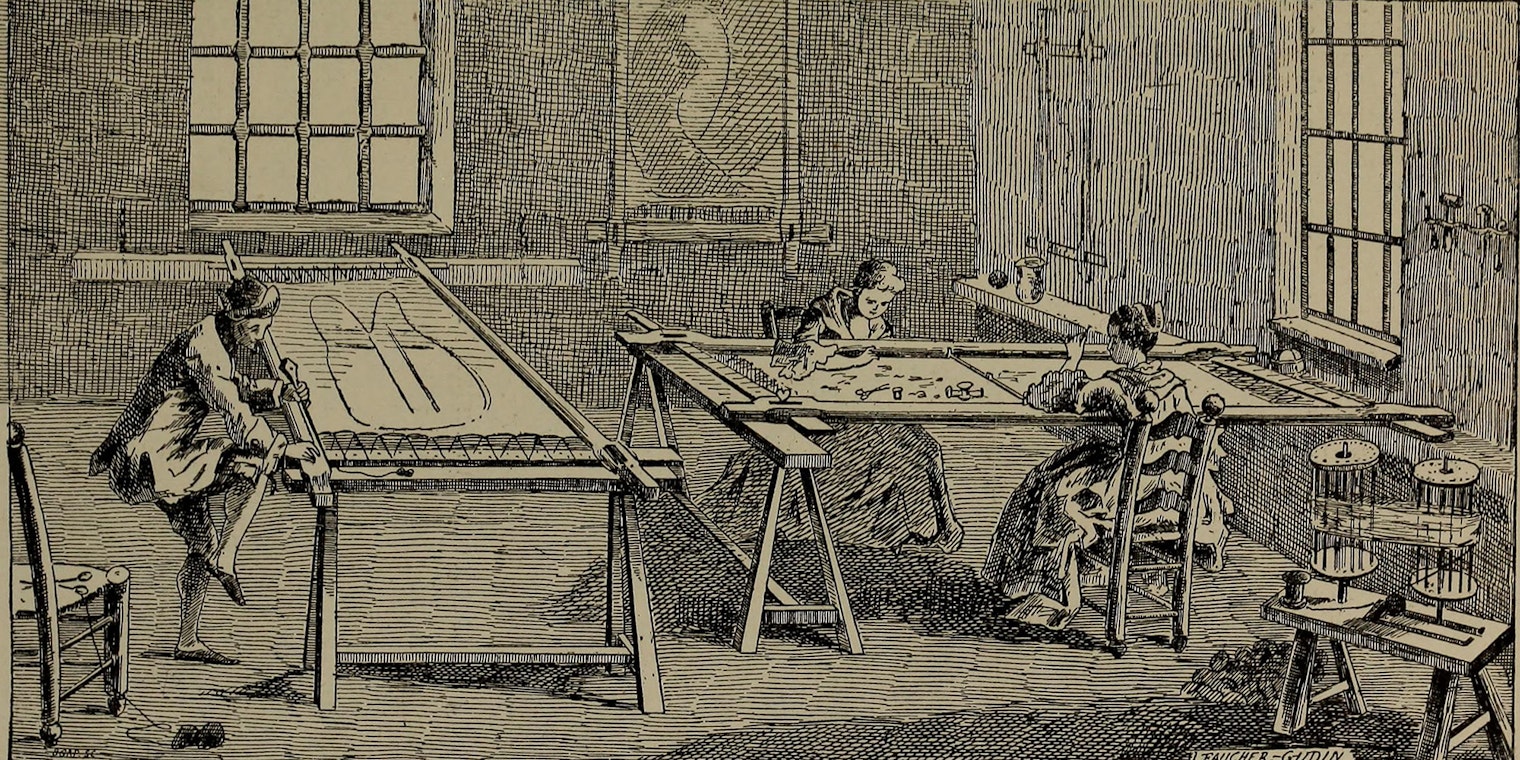
The idea of using a frame to stretch fabric or canvas dates to the 1400’s and many of the frames we use today are not much different than the frames from back then. Those ancient needlework tools are referred to as tambour frames and slate frames. A fresco painting from 1470 by Francesco Del Cossa, the Triumph of Minerva, shows an embroidery slate frame in use. These square or rectangular wooden frames were often set on a stand or trestle to support the project while stitching. They were adjustable, using holes or slots, and pegs to adjust the dimensions. The project was attached to the frame using a heavy thread to stretch the fabric being stitched. This type of frame was particularly suitable for embroidery with heavier fabric or mesh grounds.
 Francesco Del Cossa’s Triumph of Minerva, image courtesy of Wikimedia Commons
Hoops which were constructed with an outer and an inner ring became available at the same time that tambour embroidery (embroidery worked with a fine hook, instead of a needle) rose in popularity. The word tambour is French for drum, and these circular wooden hoops allowed for the fabric to be pulled so that it was extremely taut—which was necessary for the hook to penetrate the fabric. It is believed that tambour work originated in India in the seventeenth century, and became popular in England and Europe in the eighteenth century.
In addition to the advantage that a tambour hoop could be wrapped to protect the delicate working fabric, hoops were also more portable than frames. Portability was very useful for pieceworkers, those who had to seek elusive sources of outdoor light, and also for ladies who were rarely seen without the handiwork that occupied their time. In 1903 a patent was awarded to Helen Harmes of Missouri for the Adjustable Embroidery Hoop. The diameter of the hoop could be adjusted to fit the working area of a design. This invention greatly increased the popularity of embroidery in the early 1900s, and was a precursor to the adjustable hoops of today.
 F.A. Edmunds kindly provided the hoops shown in our Twelve Months of Ornaments collection, available to All-access subscribers. Photo by Katrina King
The F.A. Edmunds Company began producing needlework frames in the 1950s, and the first frame was a rug frame which produced for the Sears Roebuck company. Eventually, because of their woodworking capabilities, the F.A. Edmunds Company was asked to produce frames for other needle arts, and by the 1960s they began to make scroll frames, tapestry frames, quilting hoops and quilting frames. As the twentieth century needlework world evolved, most of the ideas for these frames came from customers and needlework enthusiasts, and all of the modifications help make the art of stitching more enjoyable for the modern stitcher who stitches any of a variety of world techniques.
Dennis Clegg uses his spare hours to pursue recreational activities such as golfing, biking, and fishing. He resides in the Chicagoland area with his wife, Becky. Dennis is the President of F.A. Edmunds.
More from PieceWork
 Discover a Digital Home for Knitting and Crochet HistoryThe Center for Knit and Crochet is building a free, open-access digital museum where collections big and small, famous and personal, finally have a home. Jennifer Lindsay · July 20, 2026
 Hooked on History: The Surprising Collection of Hamilton House RugsA visit to a historic mansion in Maine revealed an unexpected collection of hooked rugs that inspired this dazzling rug-hooking project in PieceWork.Karen Elting Brock · July 16, 2026
 Honiton Lace: One of England’s Loveliest LacesExplore the history of this British bobbin lace with a pattern to try yourself, plus a bonus deep dive into a Bucks Point lace edging.Jo Ann Eurell · July 13, 2026
 Long Thread Podcast: Loretta Pettway Bennett, Gee’s Bend QuilterSeason 15, Episode 2: A fifth-generation quilter from the legendary community of Gee’s Bend, Alabama, Loretta Pettway Bennett turns well used cloth into her own expressions of color and community.Anne Merrow · July 11, 2026
 Explore Our Cabinet of Wonders! Discover textile treasures from museums around the world in our Fall 2026 issue of PieceWork.Karen Elting Brock · July 9, 2026
 Flower Power! Vintage Flowers Made SimpleFrom fabric blossoms to daisy loom flowers, learn how to make your own little garden with these vintage techniques. Karen Elting Brock · July 6, 2026
 And He Called It MacaroniIf you’ve ever wondered at the meaning behind the lyrics of “Yankee Doodle,” it might surprise you to learn that the “macaroni” in the song referred not to a noodle, but to a rather odd fashion trend.Christina Garton · July 2, 2026
 Stitching America’s Story: A 500-Foot Quilt for the Nation’s 250th BirthdayAs our nation approaches its 250th birthday, learn about one quilt that aims to stitch together the stories, struggles, and triumphs that built America.Erin Rodewald · June 29, 2026
 The Sparkle of Tradition: How Nineteenth-Century Europe Perfected Knitting with BeadsFrom the Baltics to Britain, learn how nineteenth-century knitters transformed simple wrist warmers and sleeves into dazzling garments with hundreds of tiny glass beads —and get the pattern to knit your own!Carol Huebscher Rhoades · June 25, 2026
 Stitching a Tribute and a MemoryWhat do we do with needlework heirlooms that we cannot let go?Linda Ligon · June 22, 2026
From the Library


Comments
No comments yet — be the first to share your thoughts.
Sign in to join the conversation — commenting is for signed-in members.