
Loading the latest stories…
L. Frank Baum, as a clever spinner of stories, while writing a magical tale for children was also using Jinjur and her army as an allegory for the women’s suffrage movement, to which he was no stranger.
Joanna Johnson4 min read
L. Frank Baum (1856–1919) is widely known as the author of The Wonderful Wizard of Oz, which was published in 1900 and in 1939, as The Wizard of Oz, made into the most watched film of all time. Nonetheless, nearly every publisher in Chicago refused the book initially because of its fantastic subject matter and extensive color plates, which were very expensive to print. George M. Hill was finally persuaded to take a gamble on it, and the modern American fairy tale became the best-selling children’s book of 1900.
I first discovered this and the thirteen other Oz books in Baum’s original series (published between 1904 and 1920) as a girl while exploring the children’s nook of our small town library. Located at the top of a shaky, open-backed staircase in a damp old grist mill, the library housed a musty collection of fabulous books. Reading through the original Oz books time and again, I was captivated by Baum’s bizarre fantasy world and by the stunning Art Nouveau–inspired illustrations by W. W. Denslow (1856–1915) and John R. Neill (1877–1943). Among the characters introduced in the second book of the series, The Land of Oz, are a living Saw-Horse, Jack Pumpkinhead, Mombi the witch, the elklike Gump, the Woggle-Bug, and Tip, the story’s young hero.
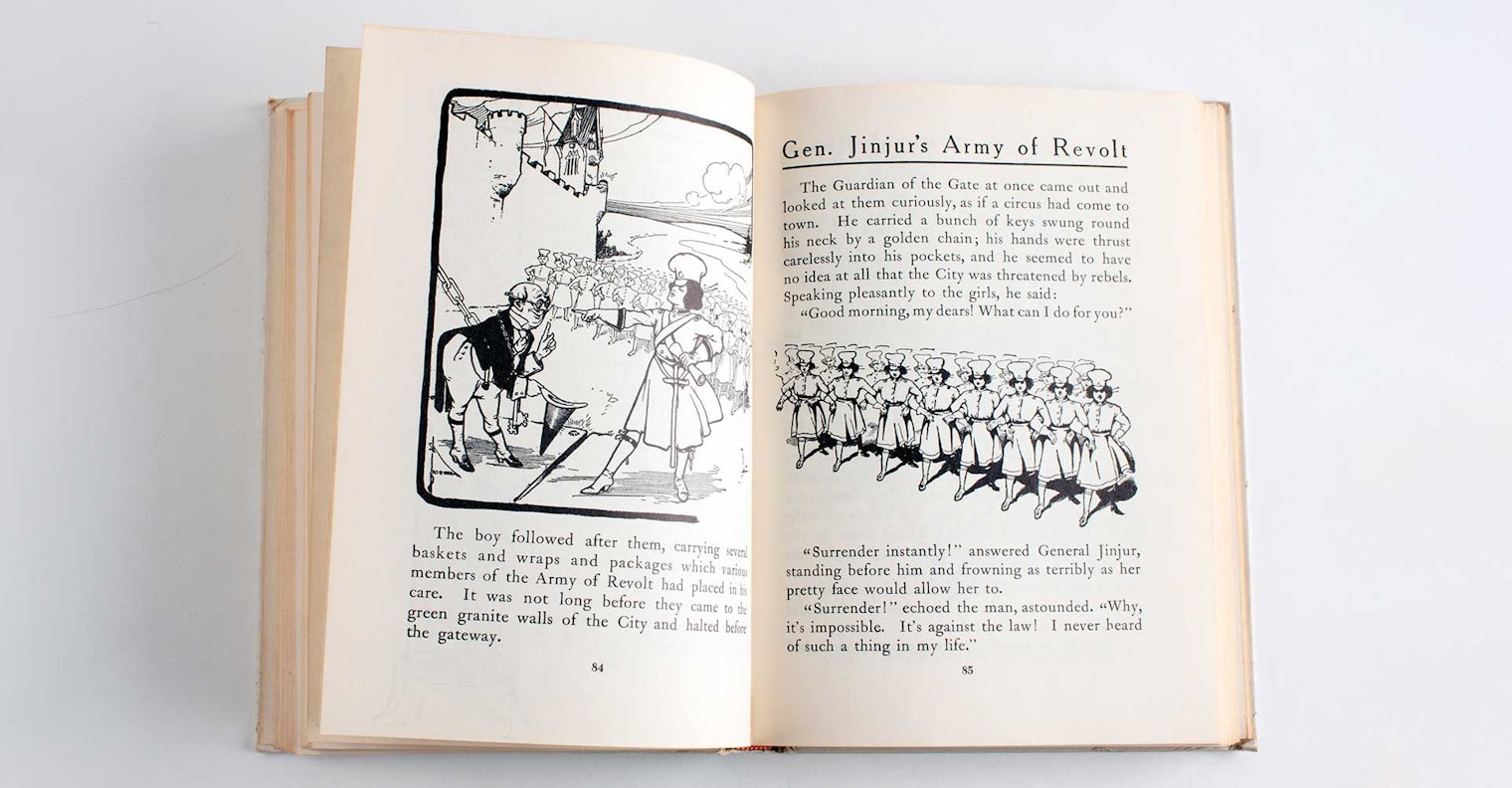
Journeying on foot to the Emerald City, Tip comes upon a girl sitting by the side of the road. She is General Jinjur, the commander of the all-girl Army of Revolt, whose aim is to defeat the Emerald City, which has been ruled by men “long enough,” and pilfer the beautiful gems to sell and use for fine jewelry. Upon meeting the other girls, “Tip thought this strange army bore no weapons whatever; but in this he was wrong. For each girl had stuck through the knot of her back hair two long, glittering knitting-needles.”
Baum, as a clever spinner of stories, while writing a magical tale for children was also using Jinjur and her army as an allegory for the women’s suffrage movement, to which he was no stranger. In pre-Oz days in Aberdeen, South Dakota, he edited the Aberdeen Saturday Pioneer and wrote an editorial in its very first issue (January 25, 1890) entitled “Equal Suffrage Notes.” He was the secretary of Aberdeen’s Equal Suffrage Club, and state and national suffrage speakers were often guests of the Baums. His wife’s mother, Matilda Joslyn Gage (1826–1898), spoke at the Women’s Rights Convention in Syracuse in 1852 and later wrote, along with Elizabeth Cady Stanton (1815–1902) and Susan B. Anthony (1820–1906), History of Woman Suffrage, which they published in four volumes from 1881 to 1902.

The cover and spine (showing General Jinjur) of The Land of Oz by L. Frank Baum with illustrations by John R. Neill (Chicago: The Reilly & Lee Company, 1904). Collection of Christina Garton. Photograph by Ann Swanson
General Jinjur and her knitting minions made their literary debut in 1904. Teddy Roosevelt had just been elected president, J. M. Barrie’s Peter Pan debuted as a stage play, and Puccini’s Madame Butterfly premiered in Milan; Marie Curie published the second edition of Recherches sur les substances radioactives, the Louisiana Purchase Exposition and first American Olympics were held in St. Louis, and the Broadway subway opened in New York City. Knitting was in an interesting place in history as well. Queen Victoria, who died in 1901, had established knitting and other handwork as desirable activities for ladies of class and leisure. In 1904, books of knitting patterns were in their infancy, but pattern newsletters such as Weldon’s Practical Knitting were very popular.
With these glimpses of 1904 in the background, I imagined myself as a knitter, a woman, and a mother sixteen years before ratification of the Nineteenth Amendment (which prohibits denying the right to vote to a United States citizen based on sex). What would General Jinjur (who, by the way, does conquer the Emerald City, steals the gems, and frees the women from their household chores) wear? What kind of dress would I choose to knit for my own daughter? [Joanna Johnson designed General Jinjur’s Jumper, featured in the eBook Victorian Times eBook: 8 Projects To Knit, for her daughter, Laurel.]

Joanna Johnson’s knitted General Jinjur’s Jumper. Our model donned knitting needles in the back of her head just for this shot. Photo by Joe Coca
Carpenter, Angelica Shirley. L. Frank Baum: Royal Historian of Oz. Minneapolis: Lerner, 1992.
Loncraine, Rebecca. The Real Wizard of Oz: The Life and Times of L. Frank Baum. New York: Gotham Books, 2009.
Rogers, Katharine M. L. Frank Baum: Creator of Oz. New York: St. Martin's Press, 2002.
Joanna Johnson is the owner of Slate Falls Press, which she operates with her husband, Eric, in Loveland, Colorado. Together they publish knitting storybooks and literary pattern collections, including Green Gables Knits. Find their books at www.slatefallspress.com.
This article was originally published in the September/October 2011 issue of PieceWork.
More from PieceWork
 Long Thread Podcast: Penelope Hemingway, Needlework HistorianSeason 2, Episode 9: In the back rooms of Yorkshire's archives and museums, textile treasures await an understanding historian.Anne Merrow · May 21, 2021
 Going Home: Visiting the Madison Knitters’ GuildIn March 2018, I went home. Not to visit relatives, but to see my knitting family, the Madison Knitters’ Guild in Madison, Wisconsin.Elizabeth Prose · April 3, 2018
 PieceWork Recommends: 50 Tips from Shetland KnittersSlip a copy of 50 Tips from Shetland Knitters, and sit back with your knitting, as you enjoy an active exchange between two expert knitters.Elizabeth Prose · December 20, 2017
 Discover a Digital Home for Knitting and Crochet HistoryThe Center for Knit and Crochet is building a free, open-access digital museum where collections big and small, famous and personal, finally have a home. Jennifer Lindsay · July 20, 2026
 Hooked on History: The Surprising Collection of Hamilton House RugsA visit to a historic mansion in Maine revealed an unexpected collection of hooked rugs that inspired this dazzling rug-hooking project in PieceWork.Karen Elting Brock · July 16, 2026
 Honiton Lace: One of England’s Loveliest LacesExplore the history of this British bobbin lace with a pattern to try yourself, plus a bonus deep dive into a Bucks Point lace edging.Jo Ann Eurell · July 13, 2026
 Long Thread Podcast: Loretta Pettway Bennett, Gee’s Bend QuilterSeason 15, Episode 2: A fifth-generation quilter from the legendary community of Gee’s Bend, Alabama, Loretta Pettway Bennett turns well used cloth into her own expressions of color and community.Anne Merrow · July 11, 2026
 Explore Our Cabinet of Wonders! Discover textile treasures from museums around the world in our Fall 2026 issue of PieceWork.Karen Elting Brock · July 9, 2026
 Flower Power! Vintage Flowers Made SimpleFrom fabric blossoms to daisy loom flowers, learn how to make your own little garden with these vintage techniques. Karen Elting Brock · July 6, 2026
 And He Called It MacaroniIf you’ve ever wondered at the meaning behind the lyrics of “Yankee Doodle,” it might surprise you to learn that the “macaroni” in the song referred not to a noodle, but to a rather odd fashion trend.Christina Garton · July 2, 2026
From the Library


Comments
No comments yet — be the first to share your thoughts.
Sign in to join the conversation — commenting is for signed-in members.