
Loading the latest stories…
Linda Ligon recalls going to the feed store with her mother and shopping for sacks for a feed-sack dress.
Linda Ligon2 min read
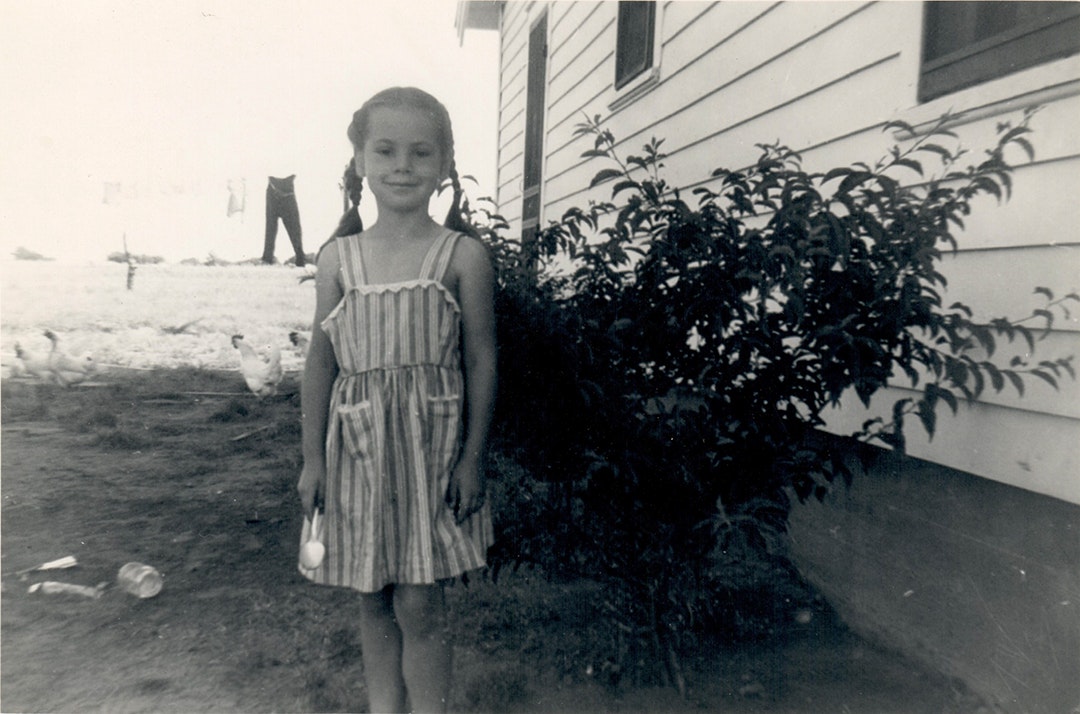
Here’s how old I am: I still have my World War II ration book! Well, I was just a baby, so that probably says more about my saving habits than my age. In poking through some of the hoard, I found this old snapshot, circa 1947. We were living out in the country in southwestern Oklahoma, and my mother had just sewn me a new sundress from chicken-feed sacks and scraps of old lace from some garment past.
I loved that dress! I remember going to the feed store with my mother and shopping for sacks. All the dainty ones, the ones with little floral sprigs, were quite picked over. We needed at least two alike, maybe three. (It wouldn’t have occurred to us to mix prints.) Brown and white stripes were all that was left. And that was okay.
See how nicely my mother matched stripes, even on the straps and pockets? Pockets! She had no sewing machine, so this was all handwork. I think of her cleverness and industry and sheer pluck, making nice things from not much. She made herself a stylish sheath dress from the pant legs of a large man’s linen suit. She unraveled a hand-me-down sweater to make a brand-new sweater. She gave the contents of my feed sacks to those white leghorn hens you see in the background, and they made eggs! From which she made me a birthday cake!
While I credit her with exceptional taste, this practice of recycling and reusing was not just her; it was near universal in those post-Depression, post-war years, at least among the working class. People were making chocolate cakes out of mayonnaise or tomato soup and “coffee” out of toasted wheat. You could think of it as deprivation, or you could think of it as problem-solving, as creative opportunity. There’s a deep satisfaction that comes from making something out of practically nothing. Wouldn’t it be great if flour and beans and chicken feed came in cloth sacks today instead of flimsy plastic? We could have possibilities instead of pollution.
Linda Ligon is cofounder of Long Thread Media and the publisher of Thrums Books.
Learn more about feed-sack cloth in the Fall 2020 issue of PieceWork.
More from PieceWork
 Rules for Teaching a Child to TatTeaching a child to tat in the oppressive Oklahoma summer heat presents certain challenges. Here are a few rules to keep in mind to make the experience more enjoyable for all involved.Linda Ligon · January 1, 2024
 Like Disappearing InkHere’s the story of how Linda Ligon's son got lost in Tunis and discovered a not-quite-magical cloak.
From the Library




Comments
No comments yet — be the first to share your thoughts.
Sign in to join the conversation — commenting is for signed-in members.