
Loading the latest stories…
Loose pages found within a different book have their own story.
Elizabeth Prose2 min read
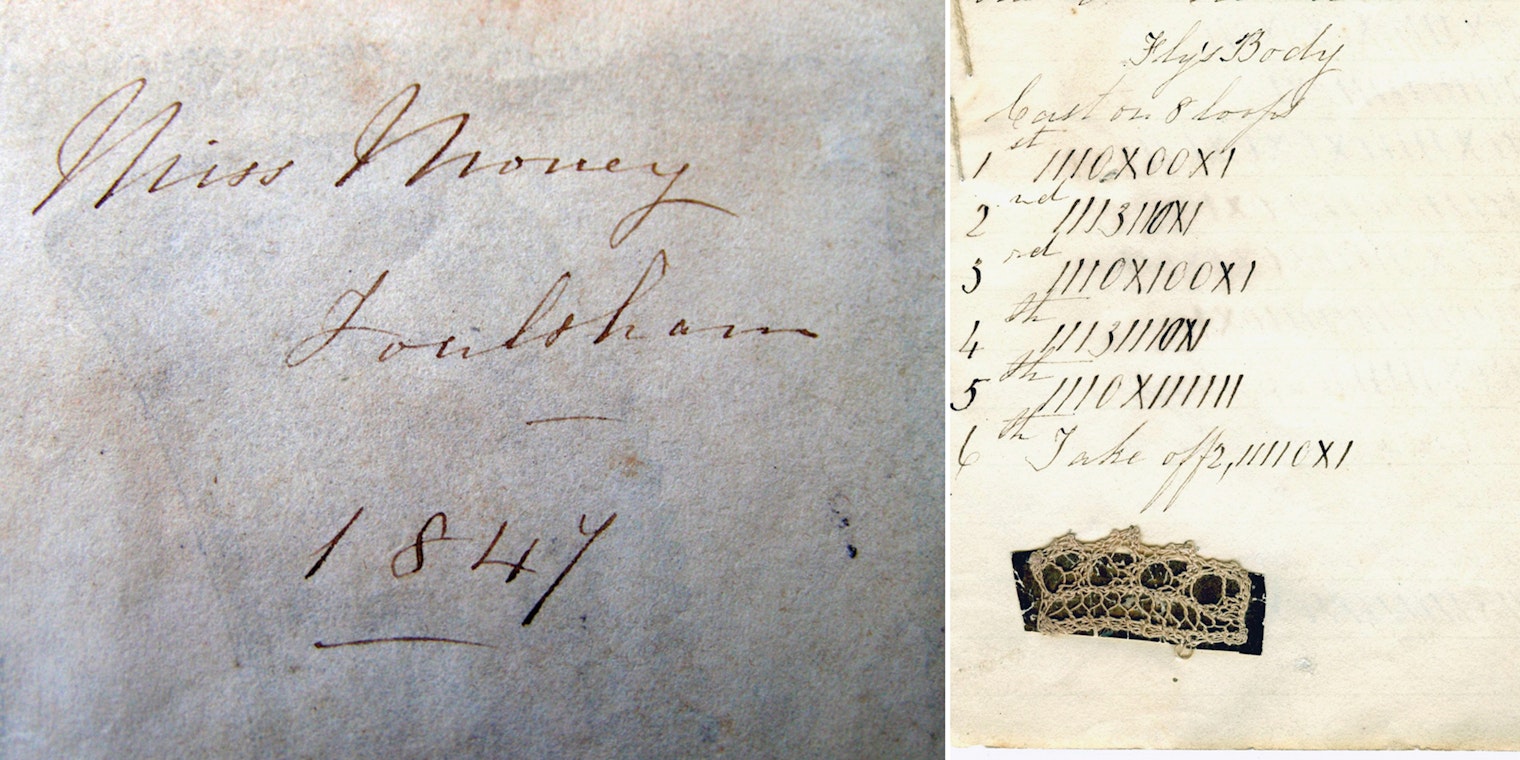
PieceWork contributor June Hall received a copy of The Ladies’ Cabinet of French Designs for Insertion Lace Cuffs, Edgings and Collars by A Parisian Lady (London: Sherwood, 1846). An inscription on the flyleaf reads, “Miss Money Foulsham 1847.” “Who was Miss Money?” is just one of the many questions this volume poses. A Victorian mystery unfolds.
 The Ladies Cabinet of French Designs for Insertion Lace Cuffs, Edgings, and Collars frontispiece (London: Sherwood, 1846),
In the January/February 2010 issue article “Who Was Miss Money? In Search of a Victorian Knitter,” June recounts what she discovered within the pages of this vintage copy of The Ladies’ Cabinet:
 Left: Miss Money’s Lace and Precious Edge patterns with original samples knitted in cotton. Right: Miss Money’s Lace pattern knitted by the author in 4-ply Shetland wool.
June’s research failed to provide any definitive answers as to the true identity of Miss Money. Yet, she was able to decipher the knitting code used by Miss Money. The key is included in the January/February 2010 issue along with several of Miss Money’s patterns. June encourages today’s knitters to make the patterns as written over 160 years ago or create your own interpretation. Thank you, June! I’m sure Miss Money would be delighted.
Interested in more historic knitting projects? This article and others can be found in the January/February 2010 issue of PieceWork.
Also, remember that if you are an active subscriber to PieceWork magazine, you have unlimited access to previous issues, including January/February 2010. See our help center for the step-by-step process on how to access them.
Elizabeth Prose is a former associate editor of PieceWork.
Originally published May 23, 2017; updated April 24, 2023.
More from PieceWork





Comments
No comments yet — be the first to share your thoughts.
Sign in to join the conversation — commenting is for signed-in members.