
Loading the latest stories…
Punto Antico (antique stitch), a type of Italian drawn-thread work, is thought to have its origins in the Levant. The geometric shapes are said to be inspired by the Arab influence that dominated the island of Sicily for centuries.
Jeanine Robertson5 min read
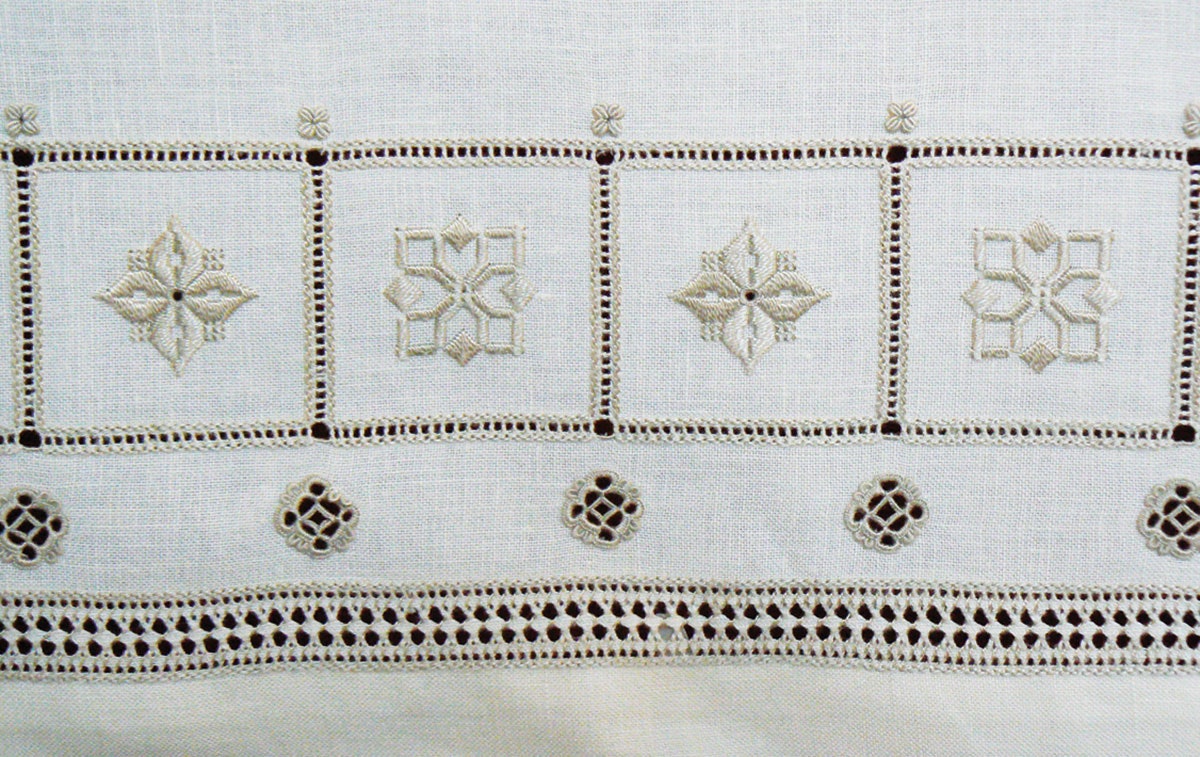
Punto Antico (antique stitch) is a type of Italian drawn-thread work similar to Hardanger that usually is worked on evenweave fabric. I first encountered the technique when a cyber friend in Italy sent me an issue of the Italian needlework magazine Rakam containing not only a how-to section on working Punto Antico in several colors but also photographs of table runners worked in ecru on ecru (I preferred the latter, monochromatic version). Intrigued, I ordered a subscription.
The characteristic geometric motifs of Punto Antico are believed to have arisen from the centuries-long Arab domination of Sicily. The term “Punto Antico,” however, first appeared early in the twentieth century to describe counted-thread embroidery worked using a particular suite of stitches (see “Punto Antico Stitches” below.)
 One of the author’s completed pieces worked in Punto Antico. Cotton on linen. Canada. 2007. Photo by Rachel Robertson
Today, Punto Antico, often combined with Punto Tagliato (cutwork), typically is worked on 36- or 38-count linen, using size 8 pearl cotton for the solid designs and size 12 for the openwork. Unlike those of Hardanger, the openwork shapes of Punto Antico are outlined in either double running stitch or backstitch, and then the center of each shape is cut diagonally to form an X from corner to corner. The resulting flaps are folded to the back of the fabric and secured with Punto Cordoncino (cord or overcast stitch) worked over the top and enclosing the double running stitch outlining the open area; the excess fabric is then cut away.
Punto Riccio (curl stitch) is executed by wrapping, then overcasting a line of stem, cable, or running stitches to create raised curls of thread that stand out from the fabric: A line of stitches is first wrapped by going under each stitch (without entering the ground fabric) to smooth out curves; then the line is overcast (again, without entering the ground fabric) with perpendicular stitches laid side-by-side to cover the whole line so that it ends up looking like a row of coils.
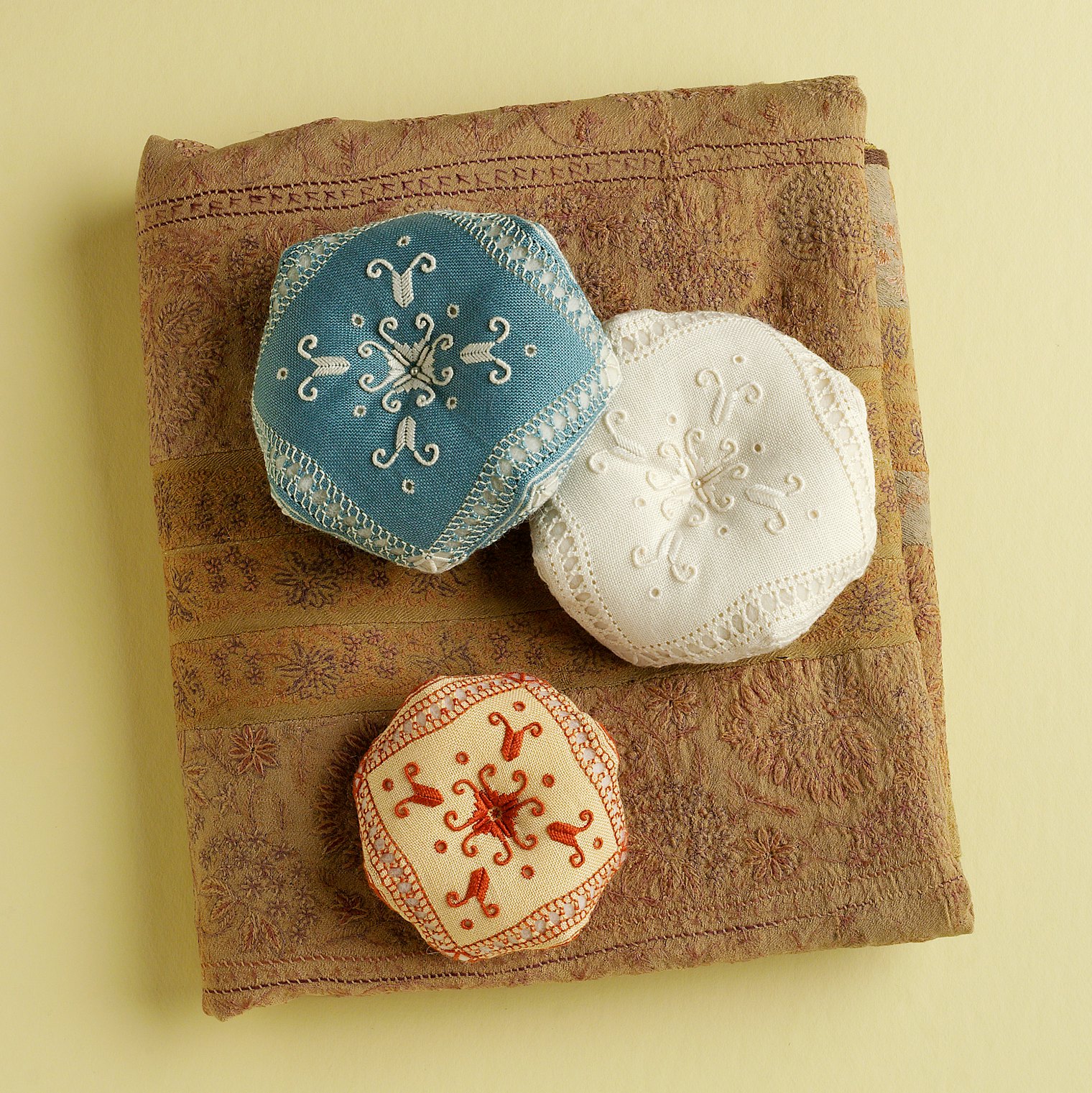 Jeanine Robertson’s Punto Antico biscornu pincushions. Download this free pattern below. Photo by Joe Coca
Another characteristic of Punto Antico is hemstitching: Single, double, and triple rows of Punto Gigliuccio (peahole hemstitch) are worked around the hemlines, and single rows join design elements within the central parts of the embroidery. In earlier examples, the open areas are small individual or groups of squares or diamonds. In later ones, larger openings were made and filled with more complex needle lace. Older pieces of Punto Antico embroidery are richly textured, having stitches over nearly the entire surface of the linen. Modern works tend toward designs that are more spacious.
Describing a seventeenth-century tone-ontone sampler in her book Ricami Italiani Antichi e Moderni Italian Embroidery Ancient and Modern, Elisa Ricci writes, “The relief of the Curl Stitch and the Satin Stitch, in contrast with the transparencies of the pulled stitch and the Reticello gives liveliness and variety to the work, and in the uniform whiteness, nearly the effect of color.” (This sampler was worked on high-count linen, not the evenweave fabric seen today.)
Because later issues of Rakam did not contain a detailed how-to section, I had to find another way to learn to do Punto Antico. A member of my local stitching guild referred me to Renate Fernau’s book Schwalm Embroidery (Berkeley, California: Lacis, 2000); I used that to learn Punto Gigliuccio. Others showed me how to do some of the stitches, which they recognized from the photographs in Rakam as classic embroidery stitches. My first project was a small doily with mainly geometric designs and very little openwork, but I was hooked. Searching the Internet for more information, I came across the website of Christine P. Bishop, an Australian needlework teacher and the author of several articles on Punto Antico. I was able to acquire these either from the publisher or on eBay.
 Various textiles worked in Punto Antico by students of the Associazione il Punto Antico, Bologna, Italy. Collection of Associazione il Punto Antico. Photocourtesy of the Associazione il Punto Antico. Photo by Paride Venturell
In 2004, I attended the American Needlepoint Guild National Seminar in Reno and took two Italian needlework courses taught by Vima deMarchi Micheli, an American needlewoman of Italian heritage who specializes in Italian needlework (see “A Fragment of Sicilian Cross Stitch,” PieceWork, March/April 1998). Vima has written more than twenty-five instructional books and owns an amazing collection of antique and modern pieces of Italian embroidery, much of which she showed us at the seminar. Vima is a generous and tireless teacher who knows all kinds of people and places, books and workshops.
Through an Italian embroidery message board on the internet, I learned of Bruna Gubbini’s book Il Punto Antico Openwork Embroidery. I was pleasantly surprised to find that it includes an English translation, as my knowledge of Italian didn’t include any needlework terminology at that time.
Originally, Punto Antico primarily was used to embellish ecclesiastical textiles and household furnishings such as table linens, curtains, pillows, and bed linens. Today it is used as well on wall hangings, lampshades, sachet bags, and Christmas tree ornaments. Made with a keen eye, the best examples of Punto Antico imitate the bas-relief of architectural designs as well as the renaissance technique of chiaroscuro, in which a third dimension is suggested by contrasting dark and light areas.
 Pillow cover worked in Punto Antico by Bruna Gubbini. Collection of Associazione il Punto Antico.
Photograph courtesy of the Associazione il Punto Antico. Photo by Pia Brevigliere
Pillow cover worked in Punto Antico by Bruna Gubbini. Collection of Associazione il Punto Antico.
Photograph courtesy of the Associazione il Punto Antico. Photo by Pia Brevigliere
Download the companion project, "A Punto Antico Biscornu Pincushion to Stitch."
Jeanine Robertson lives near Vancouver, British Columbia. She has been researching Italian needlework for many years.
Originally published December 22, 2020; updated September 1, 2023.
More from PieceWork
 Discover a Digital Home for Knitting and Crochet HistoryThe Center for Knit and Crochet is building a free, open-access digital museum where collections big and small, famous and personal, finally have a home. Jennifer Lindsay · July 20, 2026
 Hooked on History: The Surprising Collection of Hamilton House RugsA visit to a historic mansion in Maine revealed an unexpected collection of hooked rugs that inspired this dazzling rug-hooking project in PieceWork.Karen Elting Brock · July 16, 2026
 Honiton Lace: One of England’s Loveliest LacesExplore the history of this British bobbin lace with a pattern to try yourself, plus a bonus deep dive into a Bucks Point lace edging.Jo Ann Eurell · July 13, 2026
 Long Thread Podcast: Loretta Pettway Bennett, Gee’s Bend QuilterSeason 15, Episode 2: A fifth-generation quilter from the legendary community of Gee’s Bend, Alabama, Loretta Pettway Bennett turns well used cloth into her own expressions of color and community.Anne Merrow · July 11, 2026
 Explore Our Cabinet of Wonders! Discover textile treasures from museums around the world in our Fall 2026 issue of PieceWork.Karen Elting Brock · July 9, 2026
 Flower Power! Vintage Flowers Made SimpleFrom fabric blossoms to daisy loom flowers, learn how to make your own little garden with these vintage techniques. Karen Elting Brock · July 6, 2026
 And He Called It MacaroniIf you’ve ever wondered at the meaning behind the lyrics of “Yankee Doodle,” it might surprise you to learn that the “macaroni” in the song referred not to a noodle, but to a rather odd fashion trend.Christina Garton · July 2, 2026
 Stitching America’s Story: A 500-Foot Quilt for the Nation’s 250th BirthdayAs our nation approaches its 250th birthday, learn about one quilt that aims to stitch together the stories, struggles, and triumphs that built America.Erin Rodewald · June 29, 2026
 The Sparkle of Tradition: How Nineteenth-Century Europe Perfected Knitting with BeadsFrom the Baltics to Britain, learn how nineteenth-century knitters transformed simple wrist warmers and sleeves into dazzling garments with hundreds of tiny glass beads —and get the pattern to knit your own!Carol Huebscher Rhoades · June 25, 2026
 Stitching a Tribute and a MemoryWhat do we do with needlework heirlooms that we cannot let go?Linda Ligon · June 22, 2026
From the Library

Comments
No comments yet — be the first to share your thoughts.
Sign in to join the conversation — commenting is for signed-in members.