
Loading the latest stories…
In this first part of a three-part series, the author looks at the first concept—how and where girls learned their sewing skills—that is examined in an upcoming exhibition at the DAR Museum in Washington, DC.
Alden O’Brien5 min read
In this three-part series, the author examines the concepts in a sewing exhibition at the DAR Museum in Washington, DC. After reading Part 1 below, continue to Part 2 on sewing duties and technology and Part 3 on the meanings conveyed through what we sew.
If you spend any time reading 18th and 19th century women’s words—their diaries, letters, and personal account books—you realize just how much of their time could be taken up with sewing. The Ladies’ Work-Table, a sewing instruction book of 1845, said that the needle “is a constant companion throughout the pilgrimage of life.” Experiences varied, of course, across time, economic status, and region, but it can safely be said that sewing was a significant part of every American woman’s life up to at least the early 20th century. An upcoming exhibition at the Daughters of the American Revolution (DAR) Museum in Washington, DC, will examine the role of sewing in American women’s lives in the 18th and 19th centuries. The exhibition will explore both the skills and sewing process and the meaning imbued in sewn objects. Clothing, quilts, coverlets, samplers, pictorial needlework, other embroideries, and household linens will all be included, a total of more than 150 examples in two galleries. In addition, there will be a selection of contemporary examples of the themes discussed.
The first concept the exhibition addresses will be that of “mastery” of skills. How did girls learn their sewing skills, and where? Sewing was an absolutely indispensable part of girls’ education. They learned first stitches at the knee of a mother, aunt, or grandmother. Several memoirs recall the strictness of these instructors, insisting their pupil finish their “stint”—a set goal to finish rather than a timed period of sewing—and making them tear out stitches not sufficiently small or even.
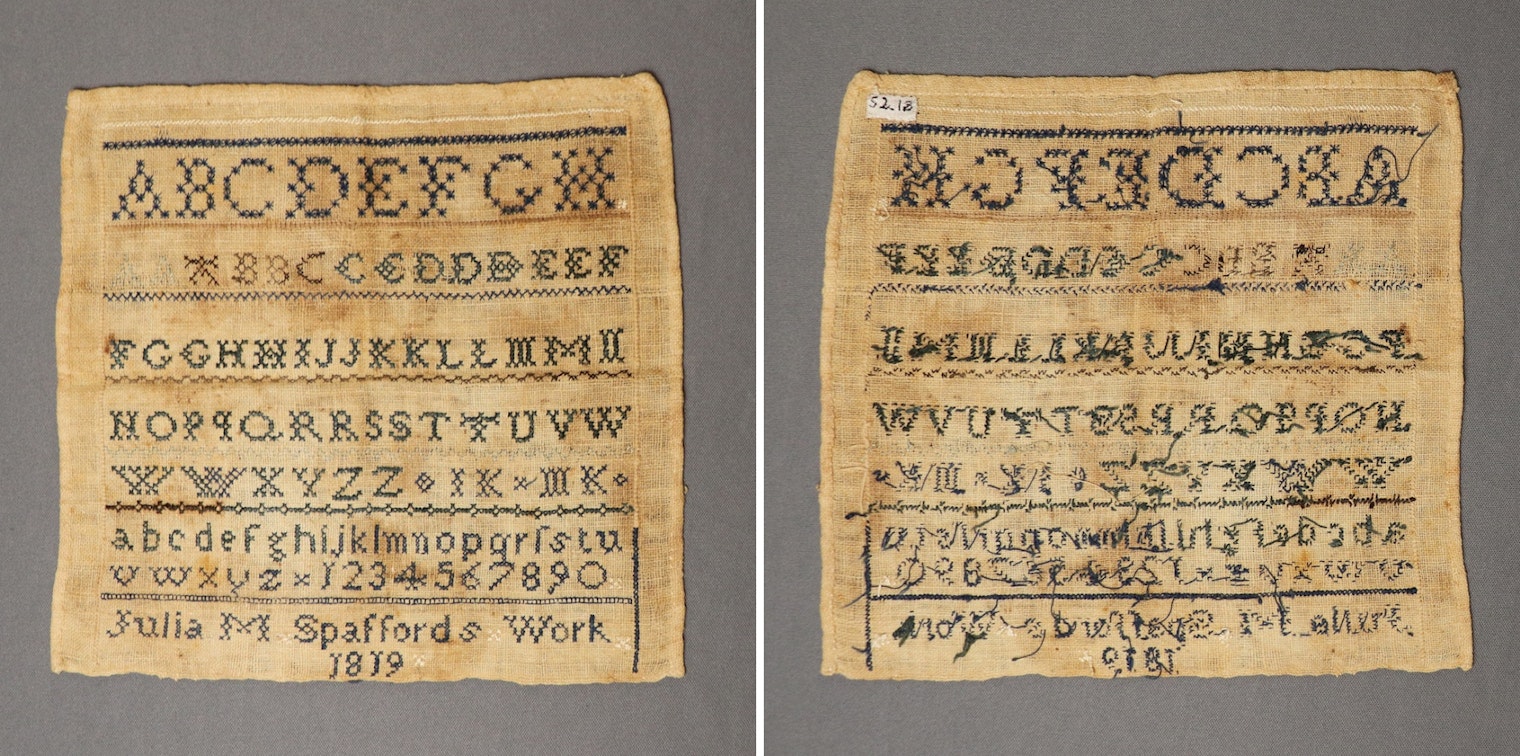
 Marking sampler by Julia Spafford, 1819. The Daughters of the American Revolution Museum 52.19, gift of Alleta Bridgeford Stapleton
Until the mid-1800s a simple sampler (above) with an alphabet—sometimes both Roman and italic, but sometimes the simplest had only one—was required, so girls would be able to mark clothing and linens with the owners’ initials and an inventory number. As ink replaced embroidery for marking linens (and this was not due to new inventions in ink recipes, but that’s another story), marking samplers were less critical, but their more decorative versions, with poetic verses or hymns and colorful floral or architectural motifs surrounded by floral borders, persisted.
 “Miss Hetty” and her quilt. The Daughters of the American Revolution Museum 89.24, gift of Rhyllis Rae Oedekoven
Nineteenth century instructors knew the power of making a task pleasurable, following John Locke’s and Jean-Jacques Rousseau’s philosophies of education. “Little girls often find amusement in making patchwork quilts for the beds of their dolls,” The American Girl’s Book or Occupation for Play Hours said in 1831, and countless parenting and sewing manuals echoed this, advising this strategy for teaching sewing. The rudimentary construction and less than tiny stitches in the dresses made for “Miss Hetty,” Hazel Richmond’s doll in the 1890s (handed down from her mother), suggest that Hazel may have made them and, perhaps, the quilt.
 Berlin work needlework, 1860–1880, The Daughters of the American Revolution Museum, 2011.17.2, gift of Leo Rocca
As academic instruction for girls improved in the first half of the 19th century, sewing was de-emphasized, and many writers lamented the decline in sewing skills among girls. The rise of Berlin work (above) with its large-scale canvas and color-coded patterns meant that less creativity was required to produce needlework pictures (and less skill, as the repetitious tent stitch replaced the greater variety of stitches and textures employed in earlier pictorial needlework—below).
 Amelia Kollock’s perforated paper sampler, wool thread, 1865–1870. The Daughters of the American Revolution Museum, Friends of the Museum purchase
But in the last decades of the century, many public schools reintroduced sewing classes. The sewing machine could not completely replace hand sewing, and the ready-to-wear industry had not really taken off in women’s wear (that would take off about 1890 and speed up after 1900). Instead of flat cross-stitched samplers, schoolgirls produced sewing notebooks.
 Eva Norris’s sewing-class notebook, 1893. The Daughters of the American Revolution Museum 2023.10, purchased with funds from the Elizabeth T. & Dorothy N. Casey Trust
Each lesson (stitch, seam, or technique) had a scrap of fabric with the technique practiced on it, sewn or glued onto a page. Some included the students’ written notes for each lesson. Beyond simple stitches, complete seaming methods, patching and darning, and even simple garment construction were included in these courses; partial sleeves with stroked gathers, and miniature petticoats, aprons, and other garments fill the pages of these sewing-sample books (The Cooper-Hewitt Museum and Winterthur Museum and Library own quite a few, some of which have been digitized, see note 1). The DAR Museum’s example by Eva Norris (above) is somewhat unusual in being mounted on cardboard pages connected with ribbon in accordion format.
Beyond sewing instruction for young girls, the 19th century offered an abundance of sewing books, some of which attempted to teach patternmaking either for those who aimed to become professional tailors or dressmakers or for the home seamstress who wanted to save money by making her own clothes. Fashionable dresses were almost entirely custom-made, and women at almost every level of society could afford at least one dress fit and cut by a professional. With one good bodice (skirts until 1870 were simple tubes of fabric, occasionally with gores, within the scope of everyone), a woman could trace a pattern to copy more for herself. Even after paper patterns were available in the last third of the century, dressmaking manuals pointed out that “a very good pattern may be secured by going to a first-class dressmaker and having a basque [bodice] cut (see note 2).”
Learning sewing skills forms a small but important part of the exhibition and flows naturally into the next topic, Making, which I will discuss in a later article.
Sewn in America: Making, Meaning, Memory will be on view at the DAR Museum in Washington, DC, from March 15 through December 28, 2024.
Alden O’Brien has a BA in art history from Barnard College and an MA in Museum Studies in Costume and Textiles from the Fashion Institute of Technology. She has been curator of costume at the DAR since 1990, and over time she has been given charge of the dolls and toys, quilts, and most recently the samplers and needlework. She has curated nearly a dozen exhibitions; the next one, combining clothing, quilts, needlework, and household linens, will open in March 2024.
More from PieceWork
 Sewn in America: The Meanings Conveyed in What We SewIn the third of a three-part series, the author looks at the various meanings behind items created over time—part of an upcoming exhibition at the DAR Museum in Washington, DC.Alden O’Brien · February 12, 2024
 Sewn in America: MakingIn the second of a three-part series, the author looks at the many sewing duties most women performed regularly, and the technology developed in the nineteenth century to assist them—part of an upcoming exhibition at the DAR Museum in Washington, DC.Alden O’Brien · December 13, 2023
 Discover a Digital Home for Knitting and Crochet HistoryThe Center for Knit and Crochet is building a free, open-access digital museum where collections big and small, famous and personal, finally have a home. Jennifer Lindsay · July 20, 2026
 Hooked on History: The Surprising Collection of Hamilton House RugsA visit to a historic mansion in Maine revealed an unexpected collection of hooked rugs that inspired this dazzling rug-hooking project in PieceWork.Karen Elting Brock · July 16, 2026
 Honiton Lace: One of England’s Loveliest LacesExplore the history of this British bobbin lace with a pattern to try yourself, plus a bonus deep dive into a Bucks Point lace edging.Jo Ann Eurell · July 13, 2026
 Long Thread Podcast: Loretta Pettway Bennett, Gee’s Bend QuilterSeason 15, Episode 2: A fifth-generation quilter from the legendary community of Gee’s Bend, Alabama, Loretta Pettway Bennett turns well used cloth into her own expressions of color and community.Anne Merrow · July 11, 2026
 Explore Our Cabinet of Wonders! Discover textile treasures from museums around the world in our Fall 2026 issue of PieceWork.Karen Elting Brock · July 9, 2026
 Flower Power! Vintage Flowers Made SimpleFrom fabric blossoms to daisy loom flowers, learn how to make your own little garden with these vintage techniques. Karen Elting Brock · July 6, 2026
 And He Called It MacaroniIf you’ve ever wondered at the meaning behind the lyrics of “Yankee Doodle,” it might surprise you to learn that the “macaroni” in the song referred not to a noodle, but to a rather odd fashion trend.Christina Garton · July 2, 2026
 Stitching America’s Story: A 500-Foot Quilt for the Nation’s 250th BirthdayAs our nation approaches its 250th birthday, learn about one quilt that aims to stitch together the stories, struggles, and triumphs that built America.Erin Rodewald · June 29, 2026
From the Library

Comments
No comments yet — be the first to share your thoughts.
Sign in to join the conversation — commenting is for signed-in members.