
Loading the latest stories…
The Art of Kofto Embroidery
Harikleia Sirmans5 min read
Part of my dowry and Greek heritage is an elaborate pillowcase that my paternal grandmother embroidered by machine. It is a white cotton pillowcase accented with cutwork embroidery in satin, buttonhole, and stem stitches. The design features stems, leaves, flowers, tiny eyelets, buttonhole bars, and a decorative azour (from French ajour meaning cutwork) border. This whitework embroidery is called kofto (Greek: κοφτό), which means “cut.” It was a very popular technique in the ’70s and ’80s in Greece.
 The author’s pillowcase with Kofto embroidery.
Kofto is an early form of needle lace, also known as Greek Point or reticella (Italian: little net). Traditionally, it is worked on densely woven white linen or cotton fabrics with white thread. Small pieces of fabric are cut out to create a design, and the raw edges are covered with buttonhole stitches to prevent fraying. Initially, kofto was used to decorate household items such as linens, pillowcases, tea towels, and curtains. As it grew in popularity, it was used to embellish clothing such as christening gowns, nightgowns, lingerie, handkerchiefs, skirts, blouses, and collars. It was often combined with beads or pearls to give the item a luxurious look. Kofto adopted various techniques such as azour borders, satin stitch, stem stitch, and buttonhole stitch.
 Detail of satin and buttonhole bar stitching.
Often, kofto is combined with drawn thread work, crochet motifs, or embroidery to create intricate designs. Drawn thread work is a type of counted thread embroidery where threads from the warp and/or the weft of the fabric are drawn. The remaining threads are stitched together with buttonhole stitches to create intricate patterns such as grids or diamonds. Crochet motifs are also a popular way to add extra detail to kofto designs. Embroidery is often used to add color or texture.
 An embellished tablecloth. Photo courtesy of Conney through Etsy
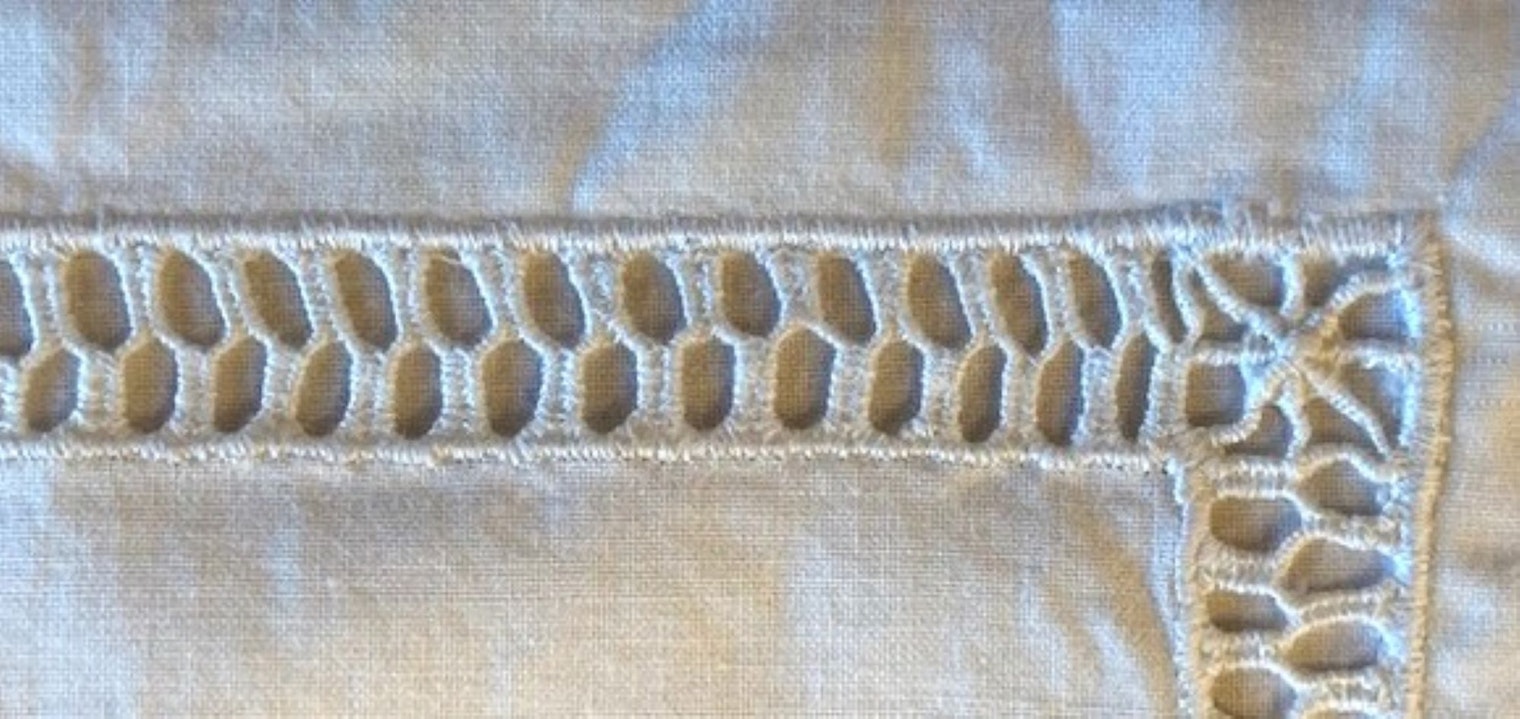
Azour is one of many drawn thread-style embroideries, used to decorate hems and borders. The narrow azour of my pillowcase weaves embroidery thread into several drawn threads of the fabric to create a pretty net pattern. The corners resemble spiderwebs.
Between 1480 and 1620 in Italy, cutwork embroidery or reticella was made by nuns in monasteries to decorate the hems of ecclesiastical vestments, the altars of churches, cerecloths, and shrouds. This was a way to glorify God, honor a nun’s commitment to the church, and provide income for the monastery. Cutwork was time-consuming and required precision, so it was done by nuns because they could dedicate more time to the work. When the Roman Catholic Church hired the poor to embroider church items, the workers began embroidering their own linens, too. This provided people with an opportunity to make money, while also allowing them to showcase their skills. Cutwork embroidery was used so extensively that it spread to other nations and took on different names, such as broderie anglaise, Richelieu, and Hardanger.
The art of reticella was introduced to the Greeks when the Venetians ruled the Ionian Islands of Greece from the fourteenth to the late eighteenth century. The Venetians produced a distinctive style of lace (Point de Venise) that uses intricate stitches in flax thread to raise the outline of motifs such as flowers and leaves. The different parts of these motifs are linked with brides (buttonhole bars) and decorated with pearls or loops (picots). This needle lace technique has the effect of carved ivory.
During Venetian rule, most parts of Greece were also under Ottoman occupation. The Ottomans produced the most elegant textiles and embroideries, including drawn thread styles that were very trendy. Embroidery on clothing exhibited the political, economic, cultural, and social status of the wearer. Ottoman and Venetian embroidery motifs were assimilated into the culture and lifestyle of Greek communities to create a fusion of Eastern Mediterranean embroidery traditions.
The designs on the earliest reticellas were stiff geometrical outlines (squares, diamonds, and triangles) worked with buttonhole stitch over cord or over threads left after others were pulled. Later, more shapes were added, such as wheels, flowers, animals, and birds; they were combined with ornate notions such as beads, pearls, and gold or silver thread.
 Details of buttonhole bars and an eyelet of my pillowcase.
When some people hear the words “cutwork embroidery,” they might imagine the drab and tedious activity of an unemployed housewife trying to break the boredom of her daily life. However, the history and art of cutwork are anything but boring. Cutwork embroidery was a symbol of wealth and power. It began as a form of drawn thread work performed by Italian nuns for ecclesiastical textiles. It was used as a form of decoration and an expression of religious devotion. From the Italian monasteries, the technique migrated to other specialties and countries to produce variations of impressive embroideries for different purposes. Cutwork became a product of amalgamated cultures and took on different names, such as reticella in Italy and kofto in Greece. This intricate embroidery technique is still popular today, with artisans continuing to use traditional methods to create beautiful home décor and clothing items.
Harikleia Sirmans is known for her many talents. Among other things, she’s an academic librarian and an expert dressmaker. She loves sewing and needlework, and every evening, she crochets to relax. She was born and raised on the island of North Evia, Greece. Today, she lives with her husband in Valdosta, Georgia, and she makes beds, sweaters, and collars for their furry kids. Visit her at grecianneedle.com.
More from PieceWork
From the Library




Comments
No comments yet — be the first to share your thoughts.
Sign in to join the conversation — commenting is for signed-in members.