
Loading the latest stories…
The Palestrina knot stitch is a highly textured, beadlike stitch belonging to the family of knotted stitches.
Deanna Hall West4 min read
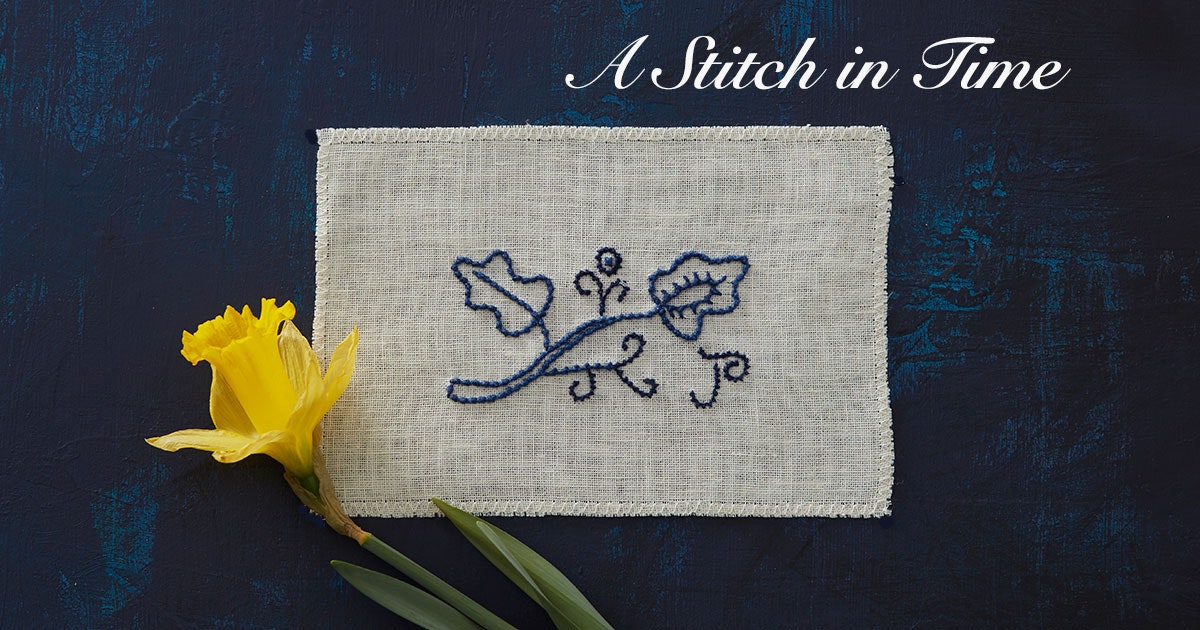
The Palestrina knot stitch is a highly textured, beadlike stitch belonging to the family of knotted stitches. It is usually composed of a line of connected knots or as a single knot. There are two distinctive variations: square and long-legged.
This attractive knotted stitch is named after the village of Palestrina, Italy, which lies 22 miles southeast of Rome. It was originally called Praeneste, a significant Etruscan town, which was built upon the ruins of the ancient Temple of Fortuna. The temple was revealed during World War II, when Allied bombing destroyed Palestrina's city center. The women of Palestrina created a very distinctive style of embroidery, using their famous knot stitch with a few additional stitches such as stem, French knot, and Bokhara couching. This style of embroidery uses thick stitching threads, usually white or natural-colored thread on dark linen or dark red, russet, or blue thread on white or light-colored linen. The village women still stitch and sell this type of embroidery. In the United States, the Palestrina knot stitch remains somewhat popular today on counted thread samplers, crazy quilts, crewel, and other styles of embroidery. I could not find any reference to date as to when this stitch was first developed, but one can assume it happened sometime after Praeneste was renamed Palestrina, which occurred sometime before that last years of the thirteenth century.


This stitch resembles the coral knot and Sorbello knot stitches, but it is more textured. Its aliases are the double knot and less frequently the tied coral, Old English knot, Danish knot, or Smryna knot (not to be confused with the Smyrna cross-stitch). The German and Dutch knot names occurred in only one reference, so their validity is suspect.
The Palestrina knot stitch can be worked, using either the stab or sewing method, horizontally (left to right, Figure 1, or right to left, Figure 2) or vertically (Figure 3) on plain or evenweave fabrics and under tension (hoop, stretcher bars, or embroidery frame) or not. Another way to work this stitch vertically is to simply turn the ground fabric 90 degrees and then stitch horizontally. Use either a tapestry needle on evenweave fabrics and a sharps needle on plain fabrics or a sharps needle on both. Pull each leg taut before proceeding to the next step to ensure the desired tight knot appearance but not so tight as to cause holes to appear in the ground fabric. The back of the fabric will display a series of short, same length vertical or slanting stitches, usually spaced evenly and equally apart. The exception to this rule is when stitching around a sharp curve or corner when the knots are spaced closer together. The individual knots may be placed so close together that they nearly touch or spaced farther apart so that one can actually see the thread connecting them. Beads can be added onto the stitching thread between the individual knots, creating a further interesting appearance. To start stitching use an away-waste knot or a small knot and to end pierce the stitches on the back, using a sharps needle. Simply weaving under these stitches does not work because the threads eventually work their way loose during wear and washing.
The solitary Palestrina knot stitch (Figure 4) is a square stitch, and it also has several alternative names including square or squared, isolated, single, small, or reversed Palestrina stitch. This variation resembles a cross-stitch but with an extra vertical or horizontal top leg and can be used in its place for added texture. In the long-legged variation (Figure 5), the first leg of the Palestrina knot stitch is elongated to create a lopsided, long-tailed or legged appearance.
For the Palestrina knot stitch, one can use almost any type of thread, but the more tightly twisted, round threads, such as tatting, pearl cotton, silk, cordonnet, buttonhole silk, or coton à boder displays the knotted character of this stitch much better.
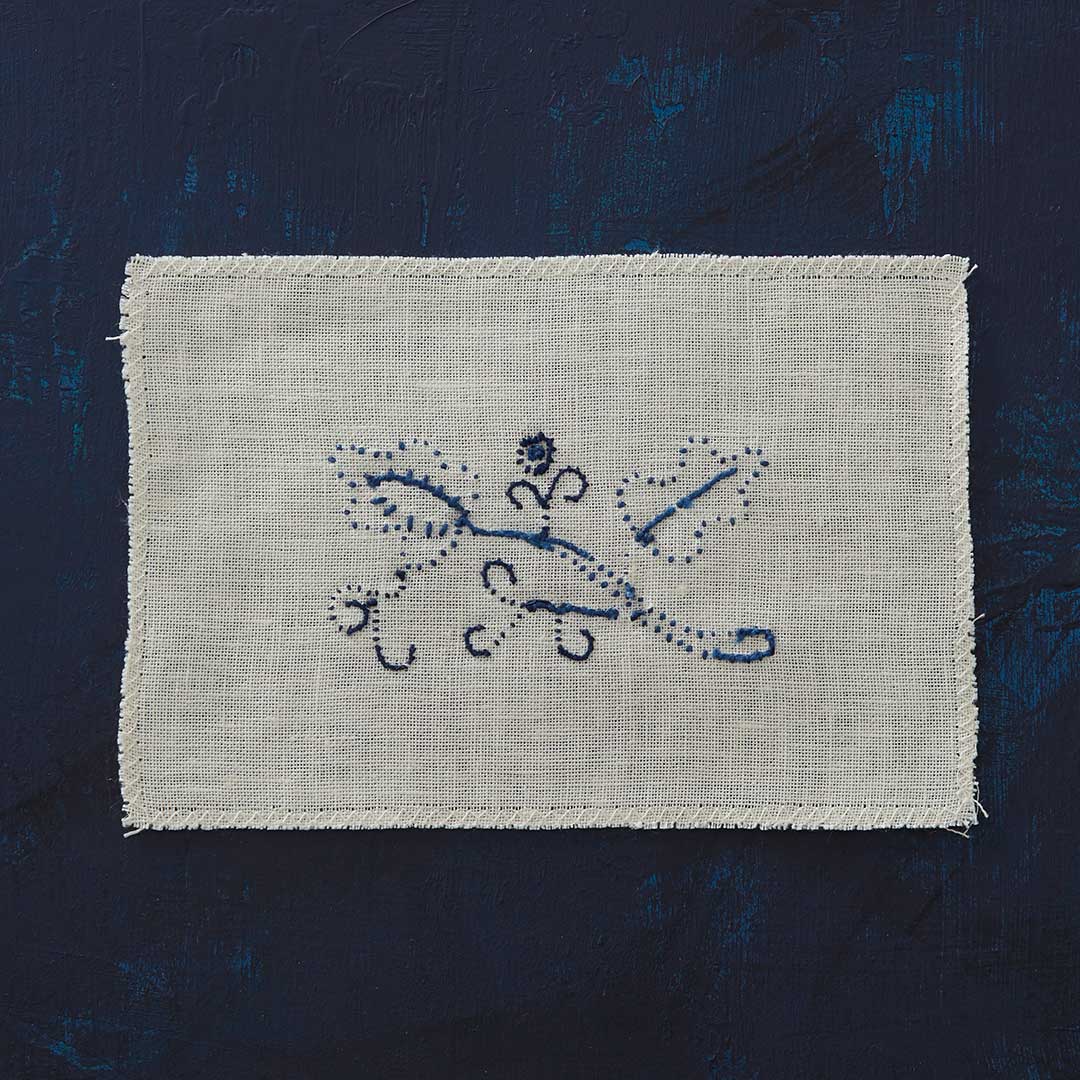
Reverse side of Palestrina knot stitch.
The Palestrina knot stitch is used for continuous straight or curved lines, outlining a motif, bands, borders, solidly filled areas (by stitching multiple rows), scroll-type alphabets, and even as an edging stitch (sewing two folded edges together or along a turned hem). This stitch is sturdy because it is tightly knotted and anchored to the ground fabric at three points. Hence, it is an excellent embroidery stitch for items like clothing, pillows, table linens, and ecclesiastic items, such as capes, stoles, and altar cloths, that need frequent washing and ironing. To maintain the texture, iron on the reverse side on a heavily padded surface. The single square Palestrina knot stitch is a useful variation for it can be used individually for powdering within a motif, as an interrupted line, or as a background filling.
Deanna Hall West is a former needlework technical editor for PieceWork and former editor of The Needleworker magazine.
Originally Published April 23, 2019, updated April 2, 2022.
More from PieceWork
 Long Thread Podcast: Emily Whitted, Texile HistorianSeason 15, Episode 3: Exploring collections of early American cloth, Emily Whitted finds stories of creativity, virtue, and the intimate lives of people from many backgrounds.Anne Merrow · July 28, 2026
 Long Thread Podcast: Loretta Pettway Bennett, Gee’s Bend QuilterSeason 15, Episode 2: A fifth-generation quilter from the legendary community of Gee’s Bend, Alabama, Loretta Pettway Bennett turns well used cloth into her own expressions of color and community.Anne Merrow · July 11, 2026
 From Ticking to Treasure: Reimagining Victorian Embroidered CasesStitch and sew a charming embroidered-ticking bag based on an 1863 pattern.Colleen Formby · May 21, 2026
 Long Thread Podcast: Curtis Gregory, George Washington Carver National MonumentSeason 14, Episode 5: Best known for his work with peanuts, renowned agricultural scientist George Washington Carver had a lifelong passion for needlework. Park Ranger Curtis Gregory shares stories about Carver’s interests in handwork and natural dyeing. Anne Merrow · April 4, 2026
 The Modern Language of TattingWhile the core of the craft has remained the same, the language of patterns has evolved over time.Katrina King · March 30, 2026
 Ceremonies and Celebrations: PieceWork Call for Submissions Spring 2027We're seeking articles and projects that illuminate the role of needlework in ceremonies and celebrations, from wedding finery to ritual textiles.
Karen Elting Brock · March 23, 2026
Ceremonies and Celebrations: PieceWork Call for Submissions Spring 2027We're seeking articles and projects that illuminate the role of needlework in ceremonies and celebrations, from wedding finery to ritual textiles.
Karen Elting Brock · March 23, 2026 Discover an Irish Crochet Masterpiece and One Woman's Journey from Hardship to LegacyLearn the story of a determined dressmaker and her daughters and their precious Irish lace wedding jacket from 1881.Lowanne E. Jones · March 12, 2026
 Mark Twain’s Invention: The Surprising Origin of the Modern Bra StrapDiscover Mark Twain's contributions not only to the literary world, but also to fashion history. Mimi Seyferth · March 2, 2026
 Mittens of Memory: Beauty and Resilience in Wartime AmericaA pair of hand-embroidered mittens from a World War II relocation camp serve as a testament to resilience and the sustaining power of craft. And you can make them, too.Susan Strawn · January 26, 2026
 Long Thread Podcast: Elena Kanagy-Loux, Lacemaker & Historian (classic)Season 13, Episode 9: Ethereal, durable, ornamental, powerful—what does lace mean to you? Through academic study and the work of her hands, Elena Kanagy-Loux teaches that lace is all of these things and more.Anne Merrow · January 10, 2026
From the Library


Comments
No comments yet — be the first to share your thoughts.
Sign in to join the conversation — commenting is for signed-in members.