
Loading the latest stories…
The student sample books provide a glimpse into some of the skills that women in the early part of the twentieth century were expected to acquire.
Piecework Editorial Staff3 min read
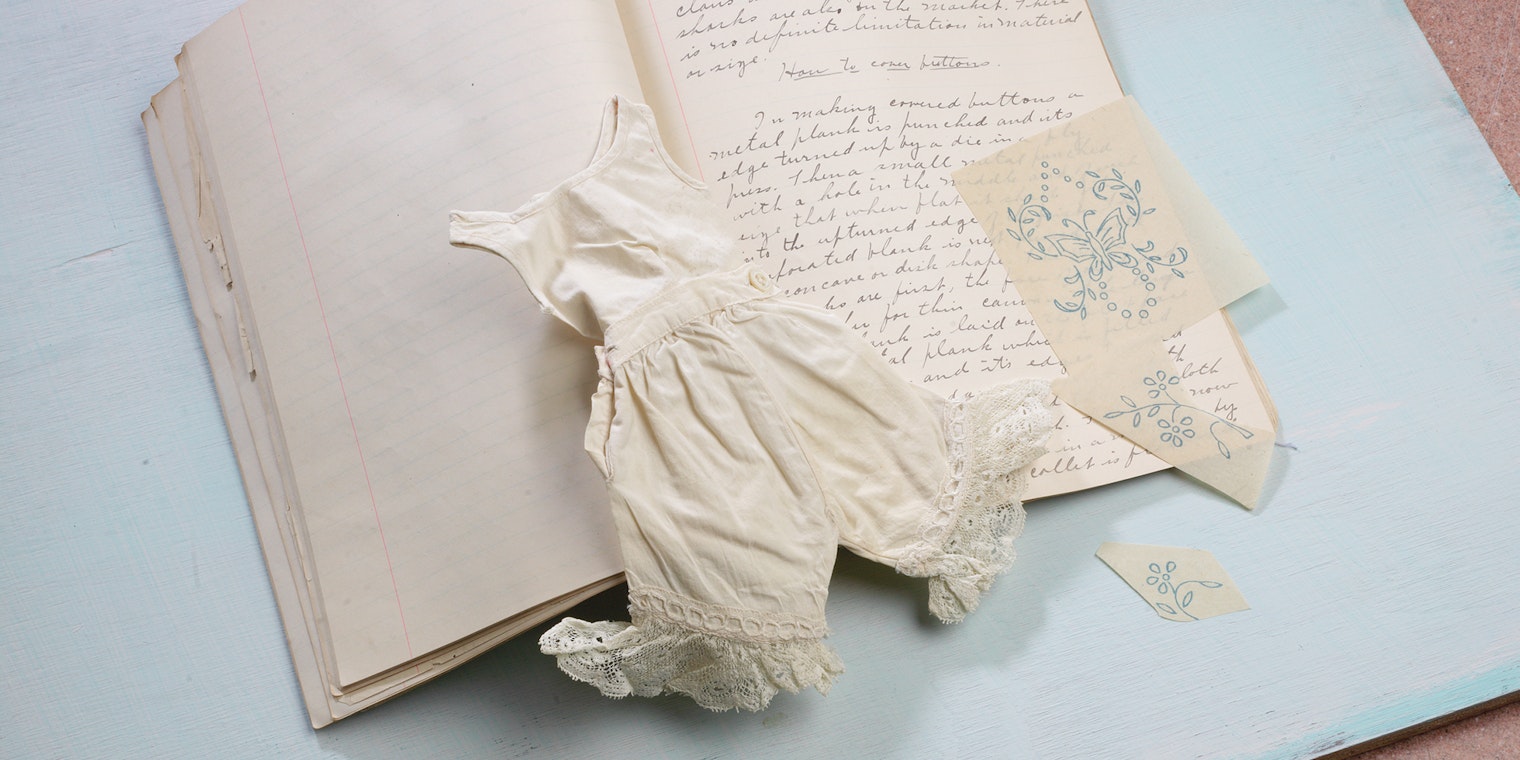
Among the 12,000 objects in the collection of the Avenir Museum of Design and Merchandising at Colorado State University (CSU) in Fort Collins, Colorado, are the two needlework sample books shown here. Inscribed in ink on the first page of the coverless sewing sample book, which museum accession records date to 1904–1908, is the name Elna Pughe. The linen-covered embroidery book is inscribed, “Property of Domestic Art Dept./Made by Junior Class/Spring Term – 1913.” (The Domestic Art building, now Guggenheim Hall, was constructed in 1910, when CSU was still known as Colorado Agricultural College.)

The embroidery sample book made by members of Colorado State University’s Domestic Art Department junior class during the spring term of 1913. The book’s cover is linen over heavy cardstock; the front cover is embroidered in satin stitch, and the book is bound with a tasseled cord made from the same thread as that used in the embroidery. (67-4-1).
Dorothy Pughe Klingler, the donor of Elna Pughe’s book, noted that Elna compiled it while a student at “Colorado College, Fort Collins, Colorado.” (Presumably she was referring to Colorado Agricultural College; Colorado College, a different institution, is located in Colorado Springs.) All of the entries are handwritten on three-hole loose-leaf paper, the pages of which are bound together by a brown shoestring. Contained in the book are information on general sewing rules; codes of conduct (keeping lockers in perfect order and “Each student is requested to wear a white apron,” for example); primitive methods of weaving; how textiles are manufactured, descriptions of various fabrics, dyeing, tape measures, pins, scissors, needles, thimbles, weaving, bed and table linens, and lace; and how to conduct fiber tests (by fire and acid, for wool, for example). Several loose stamped embroidery patterns lie between two of the pages. Also included between other pairs of pages are samples of needlework showing overseaming, narrow and rolled hems, rolled hem with lace, French seams, flat felling, tucking, gathering, shirring, stocking darning and glove mending, matching stripes, and the miniature camisole and lace-edged bloomers shown in the photograph.

The embroidery sample book made by members of Colorado State University’s Domestic Art Department junior class during the spring term of 1913, showing one of the cotton piqué pages.
Six of the pages of the embroidery sample book are made of linen; the other two pages are of cotton piqué. Each page is backed with fabric so that the backs of the stitches are hidden. Examples include chain, herringbone, buttonhole eyelet, feather, satin, and lattice stitches; stumpwork; French knots; monograms; hemstitching; and drawn-thread work.

The embroidery sample book made by members of Colorado State University’s Domestic Art Department junior class during the spring term of 1913, showing the page with an embroidered flower (top) and the page with monograms (bottom).
In the early decades of the twentieth century, most women were expected to be able to run and maintain a household. Their education, including college-level studies, focused on providing them with the skills necessary to do so. These two sample books provide a glimpse into some of the skills they were expected to acquire.
Interested in learning more about samplers? This article and others can be found in the July/August 2010 issue of PieceWork.
Also, remember that if you are an active subscriber to PieceWork magazine, you have unlimited access to previous issues, including July/August 2010. See our help center for the step-by-step process on how to access them.
Avenir Museum of Design and Merchandising, chhs.colostate.edu/avenir.
Originally published September 28, 2020; updated July 31, 2024.
More from PieceWork
 Discover a Digital Home for Knitting and Crochet HistoryThe Center for Knit and Crochet is building a free, open-access digital museum where collections big and small, famous and personal, finally have a home. Jennifer Lindsay · July 20, 2026
 Hooked on History: The Surprising Collection of Hamilton House RugsA visit to a historic mansion in Maine revealed an unexpected collection of hooked rugs that inspired this dazzling rug-hooking project in PieceWork.Karen Elting Brock · July 16, 2026
 Honiton Lace: One of England’s Loveliest LacesExplore the history of this British bobbin lace with a pattern to try yourself, plus a bonus deep dive into a Bucks Point lace edging.Jo Ann Eurell · July 13, 2026
 Long Thread Podcast: Loretta Pettway Bennett, Gee’s Bend QuilterSeason 15, Episode 2: A fifth-generation quilter from the legendary community of Gee’s Bend, Alabama, Loretta Pettway Bennett turns well used cloth into her own expressions of color and community.Anne Merrow · July 11, 2026
 Explore Our Cabinet of Wonders! Discover textile treasures from museums around the world in our Fall 2026 issue of PieceWork.Karen Elting Brock · July 9, 2026
 Flower Power! Vintage Flowers Made SimpleFrom fabric blossoms to daisy loom flowers, learn how to make your own little garden with these vintage techniques. Karen Elting Brock · July 6, 2026
 And He Called It MacaroniIf you’ve ever wondered at the meaning behind the lyrics of “Yankee Doodle,” it might surprise you to learn that the “macaroni” in the song referred not to a noodle, but to a rather odd fashion trend.Christina Garton · July 2, 2026
 Stitching America’s Story: A 500-Foot Quilt for the Nation’s 250th BirthdayAs our nation approaches its 250th birthday, learn about one quilt that aims to stitch together the stories, struggles, and triumphs that built America.Erin Rodewald · June 29, 2026
 The Sparkle of Tradition: How Nineteenth-Century Europe Perfected Knitting with BeadsFrom the Baltics to Britain, learn how nineteenth-century knitters transformed simple wrist warmers and sleeves into dazzling garments with hundreds of tiny glass beads —and get the pattern to knit your own!Carol Huebscher Rhoades · June 25, 2026
 Stitching a Tribute and a MemoryWhat do we do with needlework heirlooms that we cannot let go?Linda Ligon · June 22, 2026
From the Library



Comments
No comments yet — be the first to share your thoughts.
Sign in to join the conversation — commenting is for signed-in members.