
Loading the latest stories…
From past traditions to modern creations, discover how banana fiber is woven into beautiful garments across Southeast Asia.
Kathleen Bennett5 min read
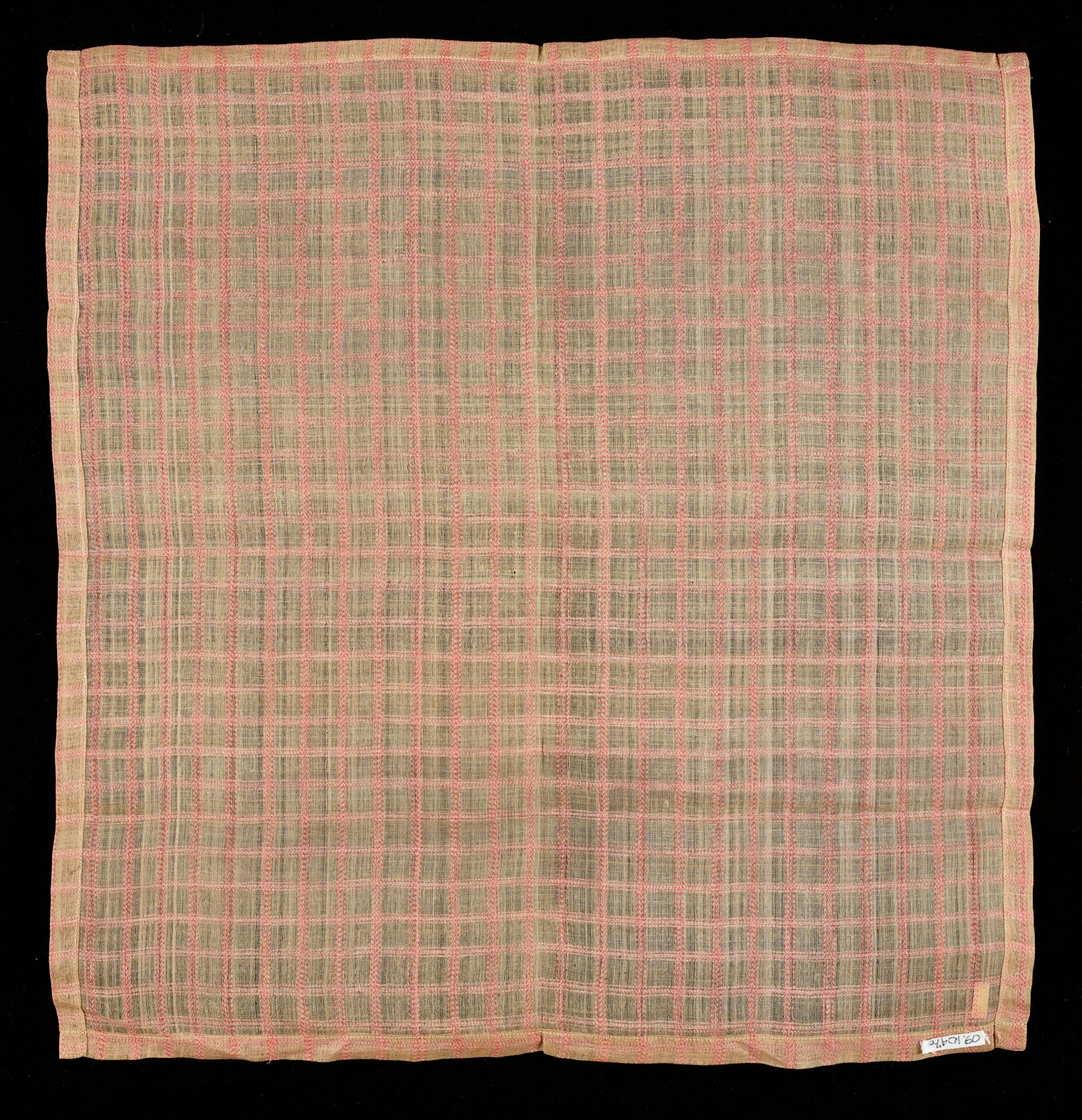
From Southeast Asia across the Pacific to Micronesia, people have been making cloth from banana plants long before their islands were discovered by Western explorers. Weavers in the Philippines, Japan, and Micronesia continue today to extract fibers from varieties of Musa plants and to weave beautiful and durable fabrics.
The oldest known banana textile (1200–1400 BCE) originating from the Philippine Islands is an intricate ikat (resist-dyed warp) burial cloth made from banana fiber and discovered on Banton Island in 1936.
 T’nalak weaver (T’boli) at Lake Sebu, South Cotabat. Photo courtesy of WayPH
Indigenous Filipino weavers agree that the art of weaving was a gift from a goddess; however, each cultural group names a different goddess. Among the T’boli “dreamweavers,” the goddess Fu Dalu brings natural and spiritual imagery to them while they sleep. These dream-inspired textiles are considered sacred and are never cut.
Banana trees have a stalk (petiole) consisting of many fibrous layers. In the Philippines, the stalks of Musa textilis are cut, pulled off as strips (tuxies) and separated into fibers of varying grades. The strong outer fibers are twisted to form salt-resistant ropes, nets, and matting. The finer and whiter inner fibers are stripped while fresh, using a knife, then washed, combed, and air-dried in the sun. After drying, they are sorted by color; the palest fibers are the rarest and most highly valued. Fibers are hand-knotted and wound into bundles that are rolled between the hands to soften them. Harder fibers are used for the warp, with the finest threads used in the weft. The T’boli beat their finished fabric and hand-polish it with a cowrie shell. The final fabric is lightweight and soft, and it does not stick to the body, even when wet.
 Woman’s blouse (bado) from Mandaya, Philippine, circa 1800-1900, made from banana-plant fiber, bast fiber, mother-of-pearl disks, metal sequins; plain weave with embroidery and appliqué. Photo courtesy of Rhode Island School of Design
While some modern weavers now use commercial colorants to add brightness, traditional groups originally used only natural dyes to produce their ikat patterns:
Coarse fiber from the outer stalk, known as Manila hemp, has long been used to make durable cordage and rope—in great demand for sail rigging and fishing nets.
The ito-basho (thread banana) or Musa balbisiana (synonym: Musa liukiuensis) was introduced to the Japanese Islands around the thirteenth century by way of China. The weaving of basho (banana fiber cloth) in Japan dates to about the fourteenth century. Fifty years ago, Japan officially designated Kijoka bashofu as an important intangible cultural property. The layers of pseudostem are pulled apart and placed into separate bundles before the fibers are removed. The outermost layer, uwaha (skin), is used for cushions, tablecloths, and household textiles; the next layer, nahau, for obi. Beneath nahau is the nahagu (inner layer), used to weave bashofu (Japanese banana fabric). Core fibers, kiyagi, break and discolor easily; these are used for thread or combined in bashofu weft.
 Child’s Robe from Ryūkyū Islands, Japan, nineteenth century banana fiber (basho) and cotton. Photo courtesy of the Metropolitan Museum of Art, 1981.359
Across Micronesia, hand-knotted banana fiber was woven into textiles several centuries before European contact. Long, ornate lengths of fabric were worn as sashes (dohr) in the Carolina Islands and as skirts and loincloths (tol) on Kosrae. On Fais Island, the tradition of weaving burial cloth (machi) of banana fiber is being revived.
 Bobbin lace edgings made of Abaca fiber, Musa Textilis on Capiz, the Philippines Islands. The five seven-inch torchon style bobbin lace samples are displayed in a red matted frame. They are numbered and labeled for the 1915 Panama–Pacific International Exposition in San Francisco. Photo courtesy of the Smithsonian American History Museum
While abaca and bashofu are woven using knotted threads, production of banana stalks and waste into spinnable fiber has been developed commercially. Like piña, spun yarn will not be as fine or soft as the individually knotted threads; it can be woven, twisted into rope, or felted into paper, tea bags, currency, and mats. Spun as thread, it can be made into lace; the American History Museum has an example of abaca bobbin lace made in Capiz, Philippines (1900–1910).
More from PieceWork
 Discover a Digital Home for Knitting and Crochet HistoryThe Center for Knit and Crochet is building a free, open-access digital museum where collections big and small, famous and personal, finally have a home. Jennifer Lindsay · July 20, 2026
 Hooked on History: The Surprising Collection of Hamilton House Rugs


Comments
No comments yet — be the first to share your thoughts.
Sign in to join the conversation — commenting is for signed-in members.