
Loading the latest stories…
Explore the tatting treasures made by an avid craftswoman that have been preserved for teaching future generations.
Karen E. Hooton3 min read
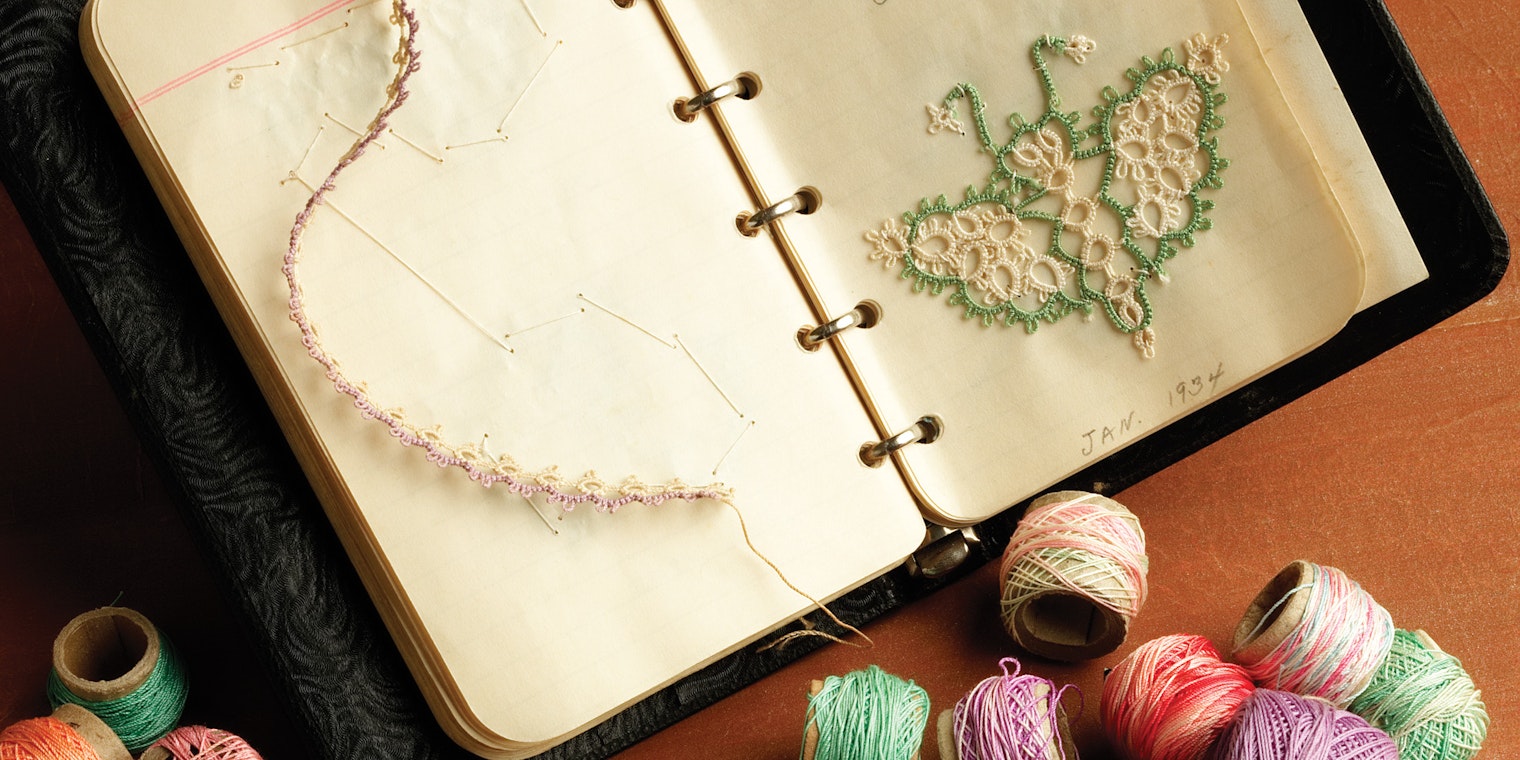
Memories of watching a friend tatting a length of lace that she hoped would one day adorn a niece’s wedding dress led me to enroll in a tatting class at Thistle Needleworks in Glastonbury, Connecticut, in the late 1990s. Our instructor was Julia Harvey, an excellent needleworker who works in tatting, lace crochet, crewel, and surface embroidery, and also does a bit of knitting. As I struggled to master the use of the shuttle, Julia, by way of encouragement to the class, produced a delightful small leather binder containing handwritten notes with samples of tatting sewn onto the pages and a small box holding several lengths of tatted lace wound on spools. As she lovingly unwound the lace, she related how the “little book,” as she dubbed it, the lace, and other objects from the box came to be in her safekeeping.
A few years earlier, Julia and a friend had been teaching thread-lace crochet and tatting in Farmington, Connecticut, when another friend told her of a relative, Irene Buckland, a tatter then in her early nineties, who was preparing to move back to her hometown of Southwick, Massachusetts. She asked Julia to meet with Irene at Irene’s home to see if she would be interested in any of Irene’s tatting supplies.
 Pages from Irene Buckland’s tatting sample book with the motif (left) that Trish Faubion used for her tatting sample available in the May/June 2010 issue.
Looking through Irene’s wonderful shuttles; threads; a collection of patterns, many of them cut from old magazines; and four pattern books, Julia came upon a children’s shoebox from the Ideal Shoe Company. Inside were the “little book,” with sample entries dating between December 1923 and January 1934; the lengths of tatted lace; and spools of thread. Julia realized that she was holding a treasure. Since her meeting with Irene, she has kept the sample book, lengths of lace, and threads in the same little shoebox and has shared them, along with other examples of Irene’s tatting materials, with all of her students.
 Irene Buckland’s tatting magazines, including the Spool Cotton Company’s 1935 Book of Tatting.
Irene Buckland was born July 17, 1901, in Southwick, Massachusetts. Like many daughters of that era, she became an avid craftswoman, turning her skilled hands to whatever was needed in her household while appreciating the pleasure her needlework afforded her. Her samples and the articles that she made testify to her extensive knowledge of tatting and excellent workmanship. Throughout her long, healthy, and happy life, she tatted, crocheted, knitted, hooked rugs, and did crewelwork. She and her second husband, Oliver Buckland, lived in Avon, Connecticut, where Oliver ran a sawmill. Irene died January 14, 1998, in West Suffield, Connecticut.
Julia has preserved Irene’s tatted-lace legacy and the instructions for re-creating her laces just as she found them. Julia says, “Even though it has been twelve years since she left this life, Irene would be pleased to have known that work she did so long ago still has a value to be shared with other women today and in future times.”
Interested in tatting one of the motifs from Irene’s book? Check out the companion project by Trish Faubion in the PieceWork May/June 2010 issue.
Also, remember that if you are an active subscriber to PieceWork magazine, you have unlimited access to previous issues, including May/June 2010. See our help center for the step-by-step process on how to access them.
Karen E. Hooton lives near a little fishing town in Scotland, with her husband, Peter. Karen thanks Julia Harvey for sharing her story about Irene Buckland’s tatting.
Originally published December 11, 2020; updated August 12, 2022.
More from PieceWork
 International Lace Day 2026: A Time of Beauty and TriumphFrom intricate handmade designs to modern textile art, International Lace Day 2026 celebrates the skill, creativity, and cultural heritage of lace makers around the world.Karen Elting Brock · June 18, 2026
 Tatting: It’s Not a Lost Art, It’s Waiting to Be RediscoveredLearn how in our new FREE beginner shuttle tatting video. It includes both right- and left-handed instructions designed to make this beautiful lace craft accessible to everyone.Katrina King · May 31, 2026
 The Modern Language of TattingWhile the core of the craft has remained the same, the language of patterns has evolved over time.Katrina King · March 30, 2026
 The Longest Night: Welcoming the Winter SolsticeAs the year’s shortest day arrives, winter solstice celebrations and Christmas markets light up towns and cities around the world, blending ancient seasonal rituals with festive traditions. Gather with us to welcome the return of the light.Karen Elting Brock · December 18, 2025
 Tat Two Holiday Ornaments Inspired by Vintage Needlework PatternsDress up your holidays with delicate charm: use these free tatting patterns to create a tree full of ornaments or a cheerful, color-filled window display.Jane Moody · December 11, 2025
 Summertime CraftingTake your shuttles on the road with this easy motif.Katrina King · June 25, 2025
 A New Collection of Quick and Portable Projects to StitchThese ten fun and travel-friendly projects showcase a range of stitching techniques and will keep you busy the whole year through.Karen Elting Brock · May 29, 2025
 Notions: Just Like Us!Step back in time to the Regency Era with the Spring 2025 issuePat Olski · January 16, 2025
 Tat a Lucky Charm!Carry your shuttles with you to fill the in-between times and create this simple motif.Katrina King · August 14, 2024
 A Handstitched Collection of Mid-Century Handkerchiefs and PillowcasesMid-century homemakers decorated their household linens and handkerchiefs with embroidery, crochet, tatting, hairpin lace, and more—a discreet way to show off their needlework skills.Charlene Marietti · February 26, 2024
From the Library


Comments
No comments yet — be the first to share your thoughts.
Sign in to join the conversation — commenting is for signed-in members.