
Loading the latest stories…
The two-sided Italian cross-stitch is a square, densely textured stitch and is another member of the large cross-stitch family.
Deanna Hall West4 min read
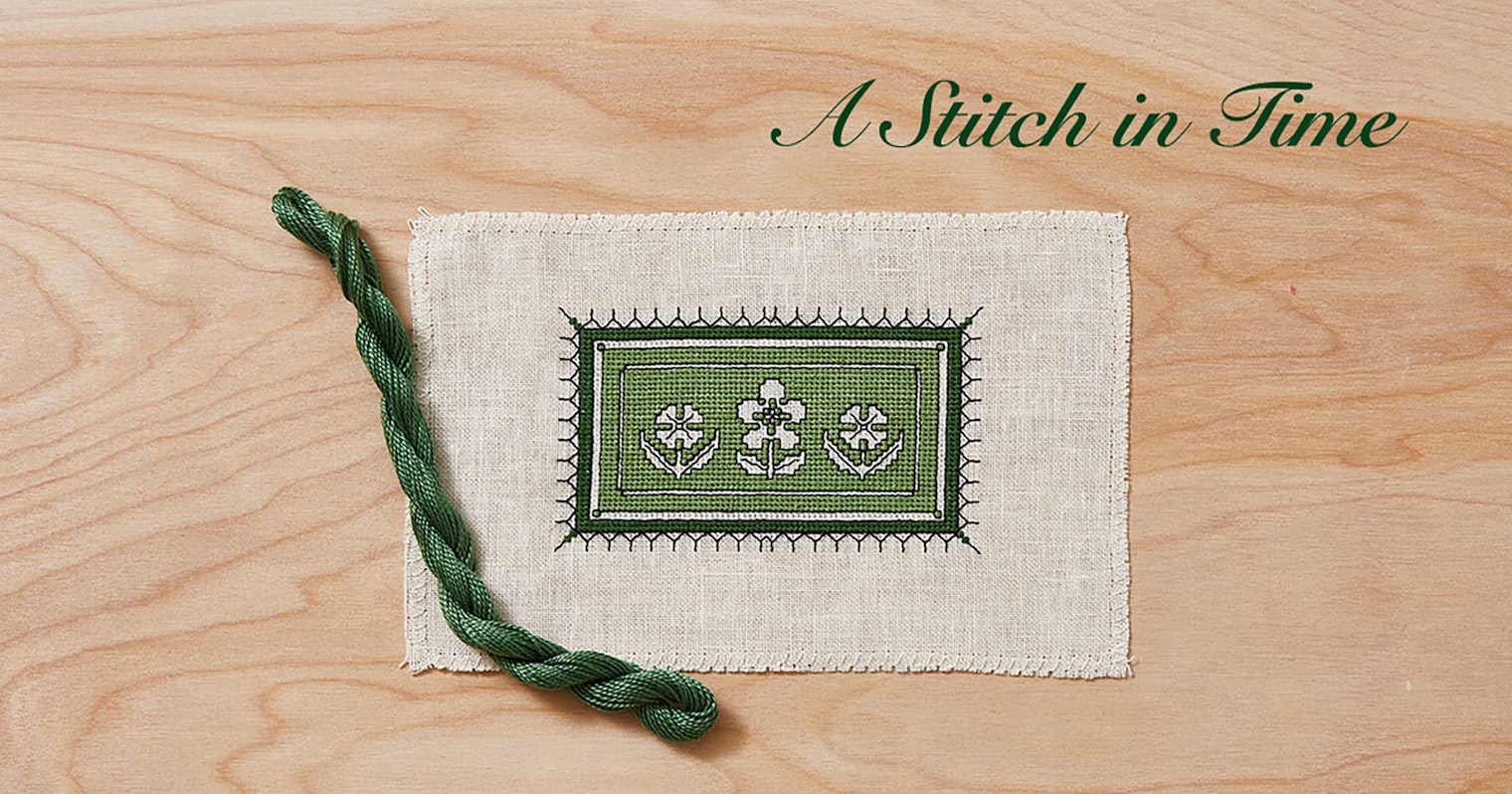
The two-sided Italian cross-stitch is a square, densely textured stitch and is another member of the large cross-stitch family. It’s composed of a single cross-stitch with two side stitches and is also known as the arrowhead cross, Italian cross, or Italian stitch. It can be worked as a stitch without tension or as a tightly pulled stitch.
Originating sometime between the 13th and 16th centuries, the two-sided Italian cross-stitch was a favorite of Italian stitchers during the 16th century. It and the long-armed cross-stitch were used as the primary, strongly pulled, background filling stitch on the earliest Assisi embroideries, which are named after a town in Umbria, a province in central Italy. Assisi embroidery probably originated with the nuns at a local convent prior to the 14th century, who worked simple designs of geometric motifs and mystical or realistic animals, birds, and flowers, which resembled the local woodcarvings and other decorative art forms. This type of embroidery was used mainly for ecclesiastical linens. Later, the basic cross-stitch was preferred for the background stitch because it’s a less complicated and a considerably faster stitch to complete.
In Assisi embroidery, the interior design is left unworked (voided or a negative image; see photo above) and is outlined with thin black or dark brown backstitch or double-running stitch. The background stitching was done in a single color, usually dark red or blue, but sometimes a dark green or deep rose was used. Additionally, this embroidery was bordered with double-running (Holbein) designs (see photo above). Assisi embroidery was generally worked on a loosely woven linen ground, and the filling stitch was pulled to create tiny holes between the stitches. Today, it is more common not to pull the stitches and to create a more solidly colored background, thus making the design more pronounced. Occasionally, today the background threads are gradated from lighter to darker colors, creating an ombre appearance. Assisi embroidery enjoyed a revival at the end of the 19th century and still remains somewhat popular today.
In the late 16th century and all of the 17th century, English needlewomen used the two-sided Italian cross-stitch on their samplers. This stitch appeared on the English Jane Bostocke sampler, signed and dated 1598, and is often referenced because it sets an absolute date for a particular stitch, stitching pattern, overall design, and stitching materials. The two-sided Italian cross-stitch also appears on 17th-century English spot samplers. American stitchers rarely used this stitch on their samplers and other needlework.
There are several stitching procedures used to complete the two-sided Italian cross-stitch, and they involve either one or two stitching journeys. I have chosen one of each type to illustrate. The others simply have a slightly different numbering sequence.
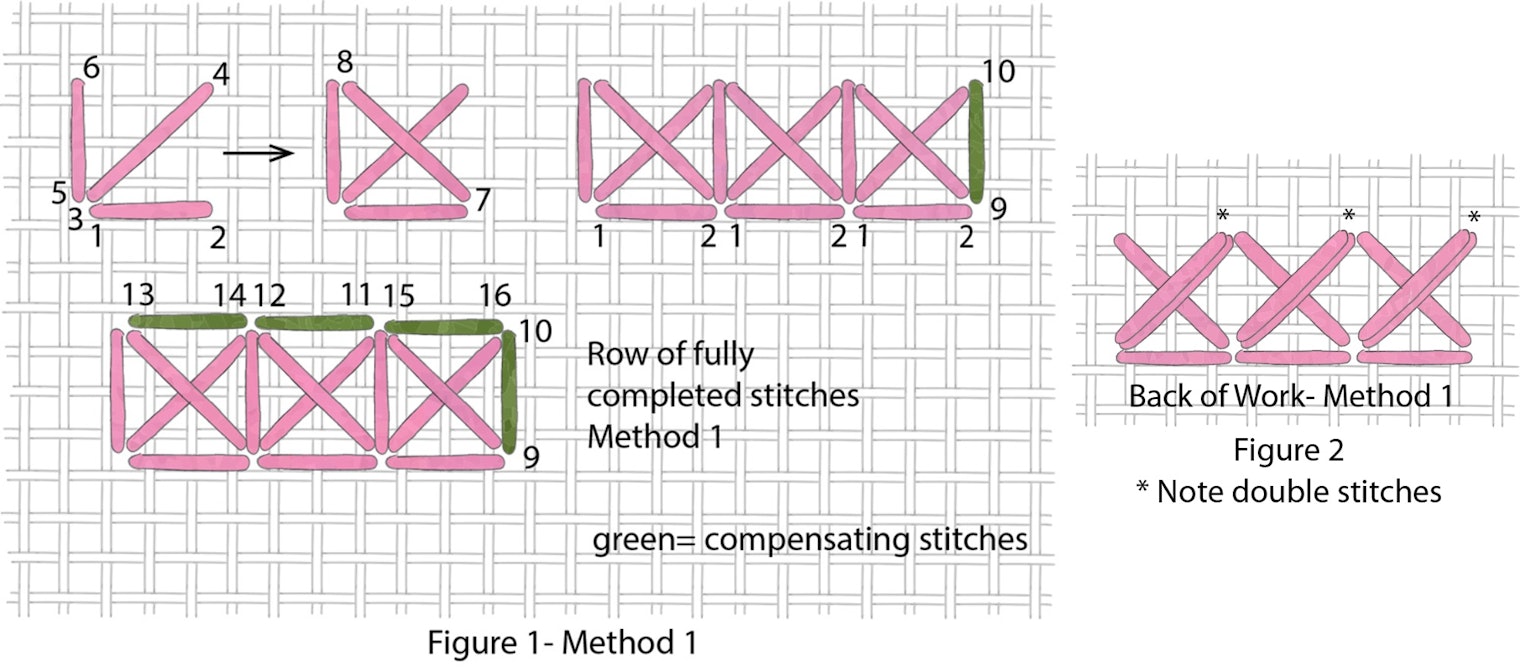
Method 1 (Figures 1 and 2) is accomplished in one journey with each stitch consisting of four steps and completed before proceeding to the next stitch.
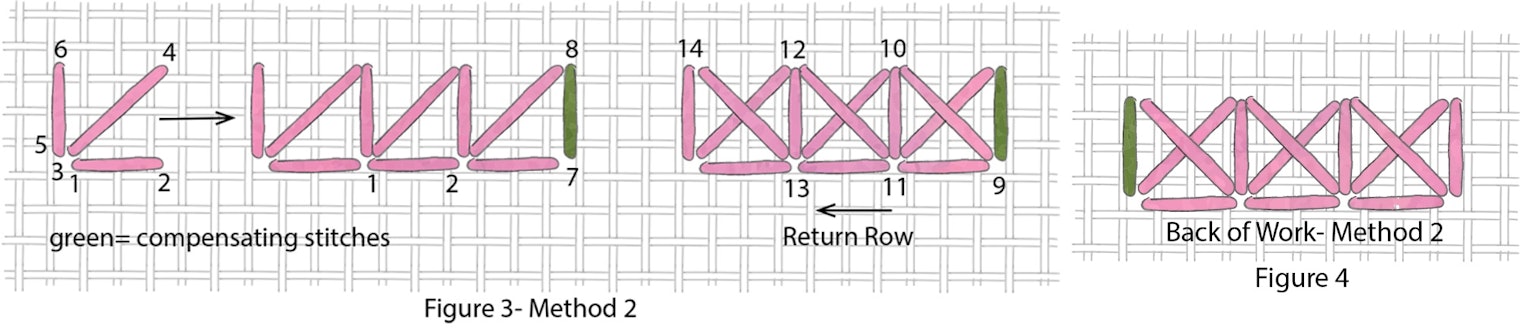
Method 2 (Figures 3 and 4) is a two-journey procedure, working from left to right and then returning along the same row with the last diagonal stitches completing each stitch before proceeding to the next row.
Some stitchers believe that this second method is somewhat neater on the back of the fabric because of the lack of double stitches (compare Figures 2 and 4). Regardless of what method used, the two-sided Italian cross-stitches are reversible (Figures 2 and 4).
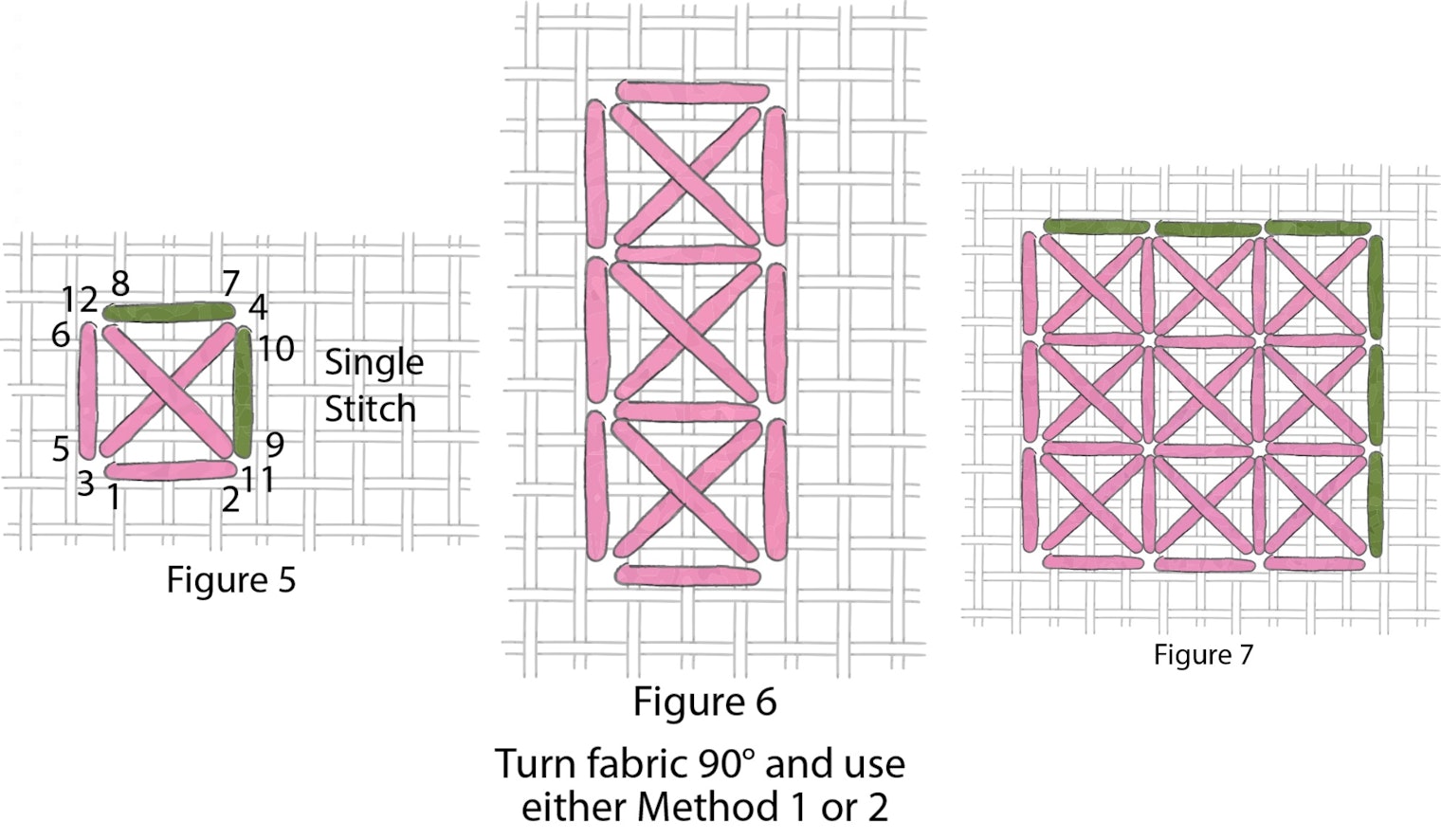
When stitched row upon row, each stitch will appear as surrounded by a straight stitched box (Figure 7). As a pulled stitch on loosely woven linen, a little or a lot of tension can be applied, resulting in very different final appearances.
Use the stab-stitch method for the best results. To start stitching, sew a few small running stitches in the area to be covered later by the two-sided Italian cross-stitching. To end the stitching, change to a sharps needle and bury the working thread deep within the stitches on the back and trim the thread close to these stitches.
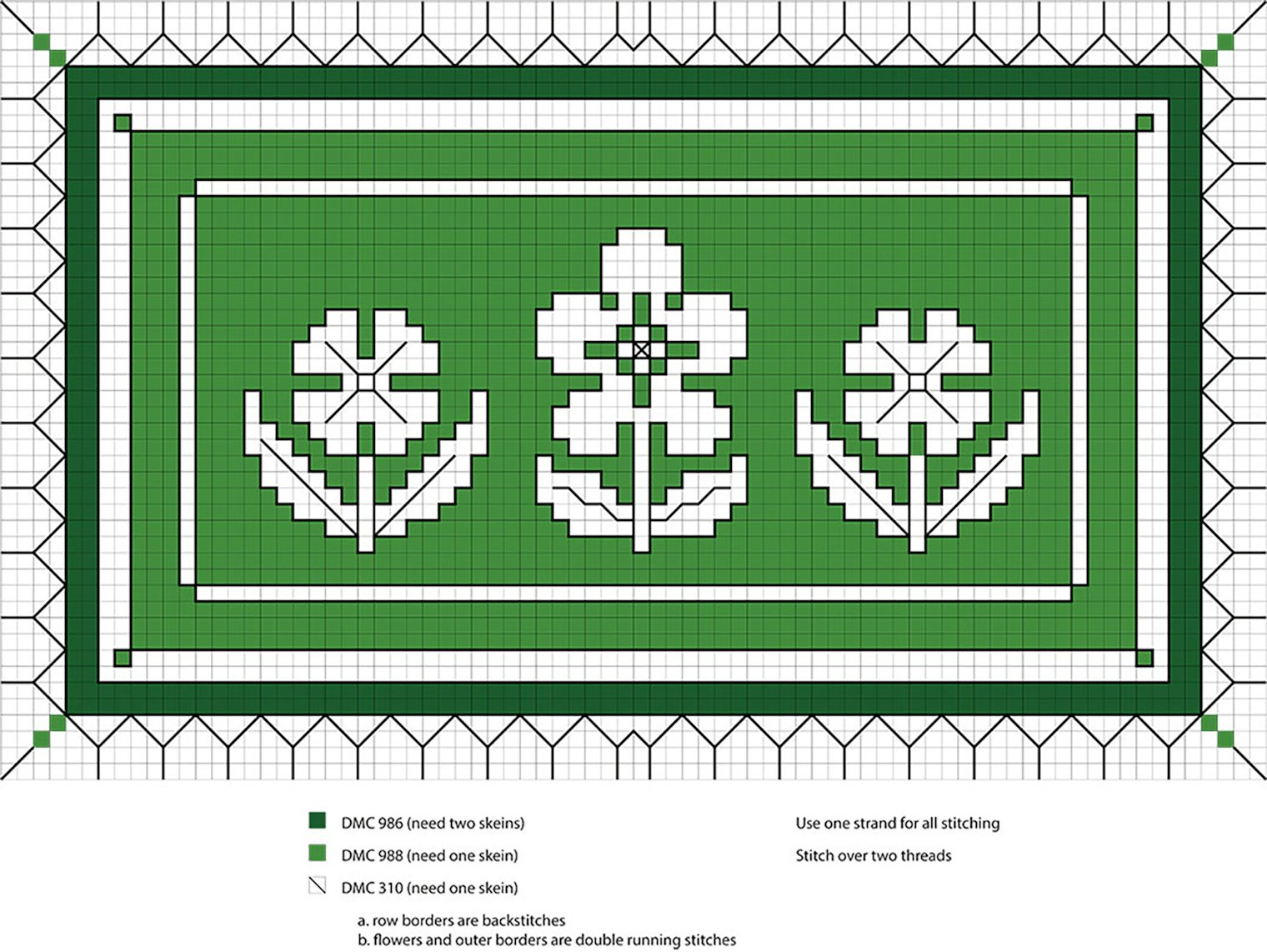
For my sample, I used Method 2 (Figure 3) and started at the top of the design and then worked toward the bottom.
 The front and back of Deanna’s work. Notice how tidy the reverse side of Deanna’s two-sided Italian cross-stitch piece is.
This stitch is traditionally worked on white, ecru, or other lightly colored evenweave fabrics or needlepoint canvas and with cotton or silk floss, coton à broder, pearl cotton thread, or yarn. Choose the correct thread or yarn size for the particular thread count of the fabric or canvas. The thread should cover the background fabric completely but not pack the stitching space.
The two-sided Italian cross-stitch can be used as a solitary stitch (Figure 5), horizontal or vertical (Figure 6) straight line, border, or filling stitch (Figure 7). Because it is a reversible stitch, it’s especially useful for items such as table napkins, bed linens, towels, and other items in which both fabric sides may be seen. Today, this stitch is primarily used for samplers, household linens, clothing panels, framed pictures, or small personal or sewing accessories, such as bookmarks, needlebooks, eyeglasses cases, and pincushions.
Deanna Hall West is PieceWork’s needlework technical editor; she previously was the editor of The Needleworker magazine.
Originally published January 16, 2019; updated August 22, 2022.
More from PieceWork
 Long Thread Podcast: Emily Whitted, Texile HistorianSeason 15, Episode 3: Exploring collections of early American cloth, Emily Whitted finds stories of creativity, virtue, and the intimate lives of people from many backgrounds.Anne Merrow · July 28, 2026
 Long Thread Podcast: Loretta Pettway Bennett, Gee’s Bend QuilterSeason 15, Episode 2: A fifth-generation quilter from the legendary community of Gee’s Bend, Alabama, Loretta Pettway Bennett turns well used cloth into her own expressions of color and community.Anne Merrow · July 11, 2026
 From Ticking to Treasure: Reimagining Victorian Embroidered CasesStitch and sew a charming embroidered-ticking bag based on an 1863 pattern.Colleen Formby · May 21, 2026
 Long Thread Podcast: Curtis Gregory, George Washington Carver National MonumentSeason 14, Episode 5: Best known for his work with peanuts, renowned agricultural scientist George Washington Carver had a lifelong passion for needlework. Park Ranger Curtis Gregory shares stories about Carver’s interests in handwork and natural dyeing. Anne Merrow · April 4, 2026
 The Modern Language of TattingWhile the core of the craft has remained the same, the language of patterns has evolved over time.Katrina King · March 30, 2026
 Ceremonies and Celebrations: PieceWork Call for Submissions Spring 2027We're seeking articles and projects that illuminate the role of needlework in ceremonies and celebrations, from wedding finery to ritual textiles.
Karen Elting Brock · March 23, 2026
Ceremonies and Celebrations: PieceWork Call for Submissions Spring 2027We're seeking articles and projects that illuminate the role of needlework in ceremonies and celebrations, from wedding finery to ritual textiles.
Karen Elting Brock · March 23, 2026 Discover an Irish Crochet Masterpiece and One Woman's Journey from Hardship to LegacyLearn the story of a determined dressmaker and her daughters and their precious Irish lace wedding jacket from 1881.Lowanne E. Jones · March 12, 2026
 Mark Twain’s Invention: The Surprising Origin of the Modern Bra StrapDiscover Mark Twain's contributions not only to the literary world, but also to fashion history. Mimi Seyferth · March 2, 2026
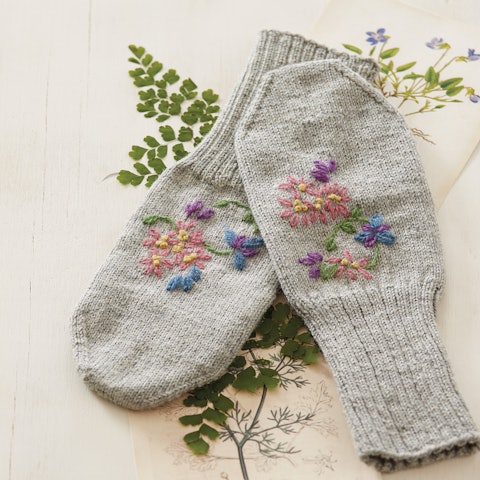 Mittens of Memory: Beauty and Resilience in Wartime AmericaA pair of hand-embroidered mittens from a World War II relocation camp serve as a testament to resilience and the sustaining power of craft. And you can make them, too.Susan Strawn · January 26, 2026
 Long Thread Podcast: Elena Kanagy-Loux, Lacemaker & Historian (classic)Season 13, Episode 9: Ethereal, durable, ornamental, powerful—what does lace mean to you? Through academic study and the work of her hands, Elena Kanagy-Loux teaches that lace is all of these things and more.Anne Merrow · January 10, 2026
From the Library


Comments
No comments yet — be the first to share your thoughts.
Sign in to join the conversation — commenting is for signed-in members.