
A Stitch in Time: The Upright Cross-Stitch
Surprisingly, the upright cross-stitch, which resembles the common plus sign, has been either ignored or overlooked in many reference books on needlework stitches.
Category
Surprisingly, the upright cross-stitch, which resembles the common plus sign, has been either ignored or overlooked in many reference books on needlework stitches.
The feather stitch and its countless variations create feathery straight or undulating lines and fall in the category of looped stitches.
The Cretan stitch derives its name from Crete, the largest Greek island in the Mediterranean Sea, home to one of the oldest civilizations (dating from at least the time of Homer’s Odyssey, around the eleventh century b.c.) and a rich legacy of embroidery.
The Portuguese stem stitch, a heavily textured line stitch, also is known as Portuguese knotted stem, Portuguese knot, and wrapped stem stitch.
The Bosnia and barrier stitches are easy to sew, similar in appearance, and share aliases. The barrier stitch is basically the French version of the Bosnia.
The rosette-chain stitch (Figures 1 and 2) belongs to the large chain stitch family because the working thread is looped on the surface of the background fabric and held in place by another stitch.
If you were limited to just one way to shape the toe of knitted socks, what method would you choose? I will occasionally ask myself silly questions like this one to promote entertaining the possibility of trying a new technique.
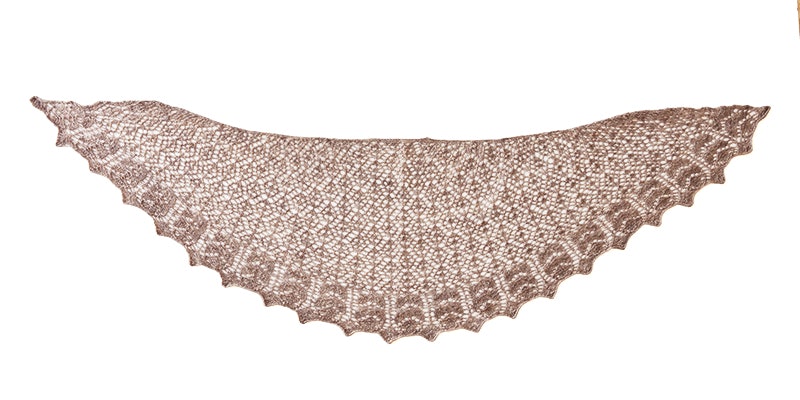
Carolyn Wyborny used a veil pattern from Volume 5 of Weldon’s as the bases for her crescent shawl featured in the May/June 2018 issue of PieceWork.
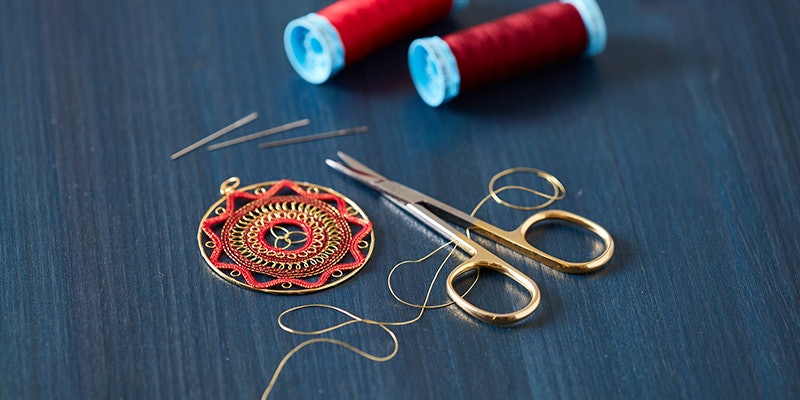
PieceWork’s 11th-annual Lace Issue, May/June 2018, explores lace techniques from around the world. Carolyn Wetzel’s stellar frisado de Valladolid-style lace medallion is the perfect introduction to a centuries-old Spanish technique.
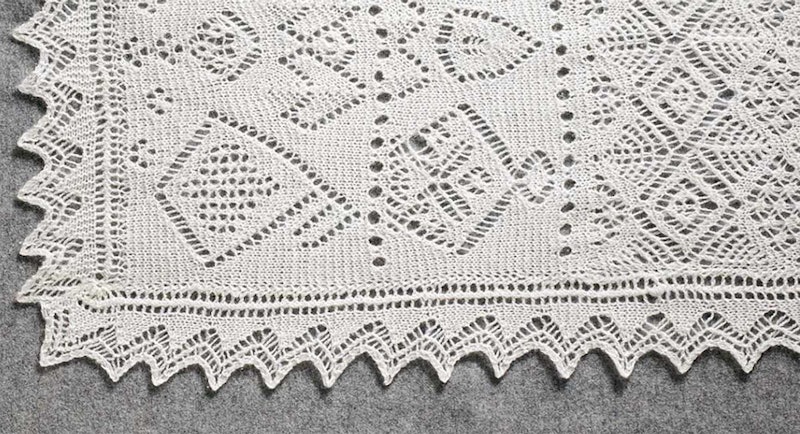
As PieceWork celebrates twenty-five years, let’s take a look back at the beginning. When Veronica Patterson wrote her editorial letter for the first issue, March/April 1993, she set the tone of the magazine for years to come.
Victorian women knitted their stockings with yarn finer than our contemporary sock yarn.
The complex, counted-thread queen stitch (American) is also known as the rococo (English) and renaissance stitches.