
A Stitch in Time: The Basque Stitch
The Basque stitch, also known as the twisted daisy border stitch, has its origins in the Basque country, located in the western Pyrenees that span the Franco- Spanish border.
Category
The Basque stitch, also known as the twisted daisy border stitch, has its origins in the Basque country, located in the western Pyrenees that span the Franco- Spanish border.
The Portuguese stem stitch, a heavily textured line stitch, also is known as Portuguese knotted stem, Portuguese knot, and wrapped stem stitch.
The Bosnia and barrier stitches are easy to sew, similar in appearance, and share aliases. The barrier stitch is basically the French version of the Bosnia.
PieceWork is thrilled to welcome Deanna Hall West back to our A Stitch in Time blog post series. Here are her latest four elegant embroidery stitches.
Researching the Roumanian stitch was very interesting but also confusing: This stitch has a number of aliases.
The Smyrna cross-stitch is another member of the large cross-stitch family and is a simple, dense, square, textured stitch worked over an even number of threads, usually four but two, six, or eight threads are not uncommon.
The rosette-chain stitch (Figures 1 and 2) belongs to the large chain stitch family because the working thread is looped on the surface of the background fabric and held in place by another stitch.

Scotland has a long and colorful history—143 meters (469.2 ft) long, to be precise! That’s the overall length of the 160 embroidered panels of The Great Tapestry of Scotland.

The Oregon Trail, pioneers, and wagon trains—these words conjure up romantic images. The reality, however, was far from romantic—it was arduous and fraught with danger; for many, it was deadly.

France bestows its highest honor—Chevalier of the Legion of Honour—on Edith Wharton for her remarkable war-relief efforts in Paris during World War I (1914–1918).
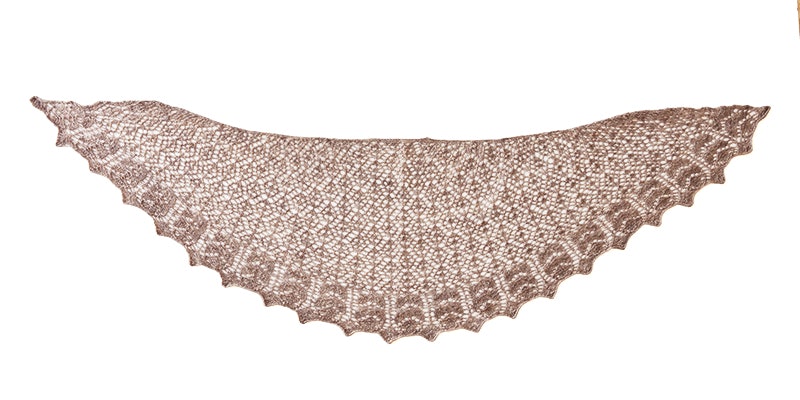
Carolyn Wyborny used a veil pattern from Volume 5 of Weldon’s as the bases for her crescent shawl featured in the May/June 2018 issue of PieceWork.
In the play Dancing at Lughnasa, five sisters struggle to survive during the 1930s in rural Ireland. Knitted gloves play a key role in the plot of the story by providing much needed income for the women.